What is a voice-first dream journal?
By Nora Bennett ·
Nora Bennett writes Notes on dreaming, the Dreamsay journal on dream science, recall, and what your own history can tell you that a dictionary can't.
A voice-first dream journal is a journal designed so that speaking is the capture, not the accessory: you talk the moment you wake, eyes still closed, and the speech becomes a searchable written record. Dreamsay is built this way. The research on dream memory gives a plain reason: at 6 a.m., the voice reaches the dream before the pen does.
That’s the short answer. The longer one is more interesting, because “voice-first” is a design argument, not a feature list, and the research behind it has as much to say about what happens after the recording as before it.
What makes a journal voice-first?
The term is young, but the logic is old: build for the person who is actually present at 6 a.m. Three traits separate a voice-first journal from an ordinary app that happens to have a microphone button.
- The voice is the capture, not the alternative. You speak the dream the moment you surface, lying down, eyes closed, before the screen lights up or the day starts talking. The design assumption is that this half-asleep voice is the most honest recording of the dream that will ever exist.
- Speech becomes text without your help. Transcription runs on its own, so every entry exists as words you can read. Audio alone fails a journal’s real test, which is review.
- What accumulates reads like a journal. Entries you can scan, search, and compare across weeks. The point was never the recording; it is the readable record that lets patterns surface.
A voice memo app does the first part and stops. A writing app with a dictation button is still a writing app: the keyboard remains the primary surface, and the keyboard is precisely what the first minutes after waking do not want. Voice-first means the whole morning is designed around speaking, and everything else is downstream of that.
Why speak a dream instead of writing it?
A dream on waking is an unconsolidated memory. The chemistry that files experience into long-term storage runs at its daily low during REM sleep, and the report persists only as long as nothing overwrites it. The alarm, the light, the first thought about Tuesday: each one is a small deletion. The capture method that works in that window is whichever one asks least of a person who is barely here.
The comparison has now been run three ways, and the results point the same direction.
| Study | Design | Written report (avg. words) | Voice report (avg. words) |
|---|---|---|---|
| Casagrande & Cortini (2008) | The same 2,144 dreams reported both ways by 302 people | 83.5 | 142.9 |
| Schredl et al. (2019) | 40 people randomized to one method for a week | 100.7 | 310.4 |
| Vallat et al. (2017) | Voice diaries kept by frequent recallers | not measured | 543 |
In the randomized 2019 study, people who spoke their dreams for a week produced reports about three times longer than the ones they wrote. Speed runs the same way: in a 2016 test of phone text entry, speech averaged 161 words per minute against 53 for the keyboard, with fewer errors. Spoken aloud, a 300-word dream costs about two minutes with your eyes shut. Typed at that hour, it costs nearer six, most of them in the glow of a screen doing its best to fully wake you. The dream does not stay for the second act.
And the extra words are not padding. The researchers’ reading is that voice reports carry the texture, the settings, the look of things: exactly the details that feel too small to be worth writing down and are usually the first to go. The 543-word voice diaries in the 2017 study are not a different kind of dream. They are the same dream, with more of it still attached.
Isn’t a voice memo app the same thing?
Here is the honest ledger, because voice has one documented weakness. In that same 2019 study, the writing group recalled more dreams across the week, 2.55 against 1.72, and drew more connections between dream elements and their waking lives, 1.63 per dream against 1.00. The explanation is mundane. A written page can be glanced at while the coffee brews; replaying your own groggy audio in real time is a chore, and chores do not happen. An archive of unplayed recordings is a diary with the pages glued together.
Transcription is the fix, and the researchers proposed it themselves, in the plain prose of a methods section: use automatic speech-to-text and let people work from the transcript. Speak first, so capture happens at the speed the moment demands; read later, so the record stays scannable. When the transcript arrives without anyone asking, the voice-first design keeps the capture advantage and gives up the review one.
Review is not a courtesy, either. Recurring dreams announce themselves only to someone who can see across entries; patterns live between records, not inside any single one of them.
What should you check before trusting one with your dreams?
Dreams are intimate in a way few records are. They arrive unedited, before the social filters clock in, and unlike a note or a photo they were never meant for anyone. So the privacy questions deserve asking of every app in this category, and they fit on three lines:
- Where does the audio go? If recordings upload to a server for processing, the most personal thing you own has made a copy of itself somewhere you will never see.
- Where does transcription run? On-device transcription turns the sound into text without the sound ever traveling.
- Is there an account? An account means a server somewhere knows your dreams exist, even on the day it stores nothing.
The strictest design in the category answers all three before you ask: transcription runs on the device itself, the recording is deleted once the words are written, the journal syncs only through your own private iCloud, and there is no account to open. Your voice never leaves your device. It is worth knowing that this exists, because it calibrates everything else on the market; you can read any privacy label in this category in about a minute and know exactly what is being offered, the same way you would audit an AI dream app.
How do you start one?
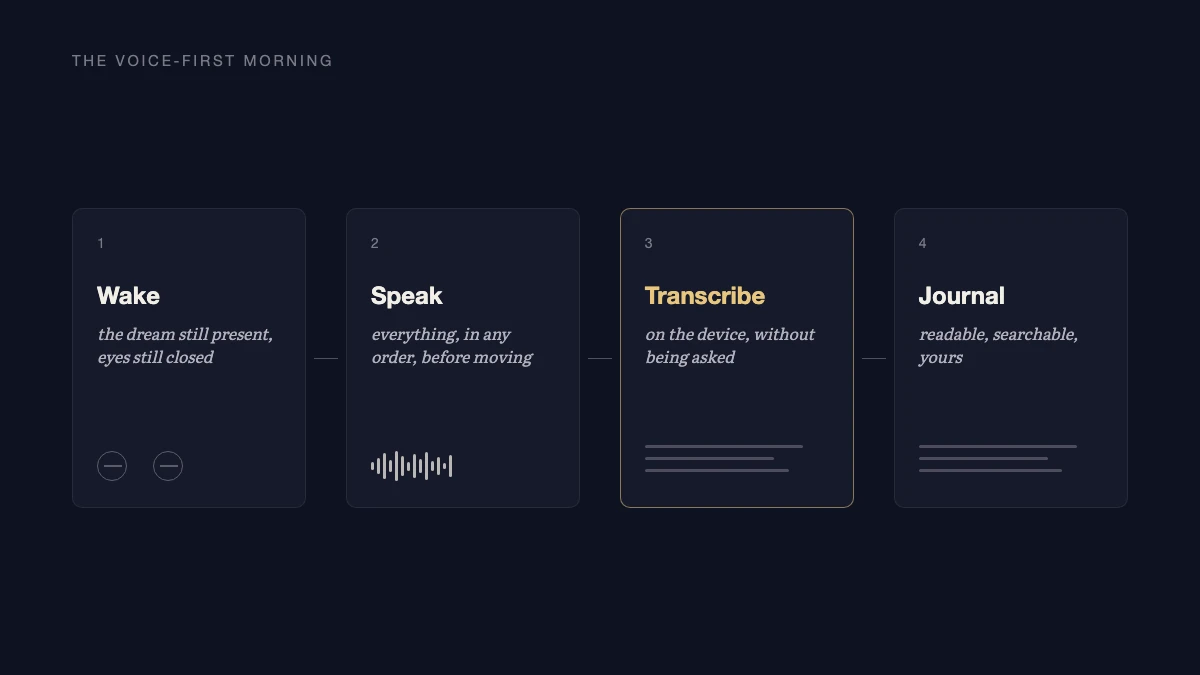
The practice is four steps and the first one does most of the work:
- Speak the moment you surface, before standing, before reaching for anything. The window is minutes wide and it does not renegotiate.
- Say everything, in any order. Fragments count. Texture is the part writing usually loses.
- Let the transcript happen the same morning, by software rather than willpower.
- Reread now and then. The journal habit itself does more work than any single entry.
The payoff for the ritual is documented. Aspy’s review of dream-recall research found that keeping a daily logbook enhances recall itself: people remember more dreams than their own retrospective estimates suggest, and the practice feeds itself. Capture keeps tonight’s dream alive. The keeping is what teaches you that you dream.
Which journal will your 6 a.m. self keep?
The design question behind voice-first is really a question about you, and you already hold the data. Think of the last dream you lost: not the one you forgot by evening, the one that was gone before you were fully awake, somewhere between the pillow and the kettle. Ask what the loss cost. Not discipline, not memory; the interface. The tool asked a half-asleep person to operate a daytime machine.
You know exactly how competent you are in that state, and how brief the visit is. Whichever journal fits that person is the one that will still have entries in it come winter. Voice-first is simply the bet that the person at 6 a.m. should not have to wait until 7 to have a voice.
Common questions
Is there an app that records your dreams by voice?
Yes, a small category of them. Apps marketed as voice or voice-first dream journals record your spoken report the moment you wake and transcribe it into a written entry. The strongest versions transcribe on the device and keep a readable, searchable archive, because a journal you cannot scan is a journal you will not revisit.
Can I just use a voice memo app as a dream journal?
For capture, yes; for a journal, only partly. Spoken dream reports hold more detail than written ones, but raw recordings pile up unheard, and patterns hide in files you never replay. Dream research has found people revisit written records more than audio. Add transcription, built in or afterward, and the voice memo becomes a journal.
Are voice dream journals private?
It depends entirely on the app's architecture, so check three things: whether recordings are uploaded to a server, where transcription runs, and whether an account is required. The strictest design transcribes on the device and syncs only through your own private cloud. In Dreamsay, your voice never leaves your device.
Does speaking your dreams help you remember them?
Speaking helps you keep them; the journal habit helps you remember more of them. Voice catches the report inside the short recall window after waking because it works lying down, eyes closed, and about three times faster than typing. Separately, research on dream recall found that keeping a daily logbook enhances recall itself.
Sources
- Schredl et al. (2019), Voice-recorded vs. written dream reports: A research note, International Journal of Dream Research
- Casagrande & Cortini (2008), Spoken and written dream communication: Differences and methodological aspects, Consciousness and Cognition
- Vallat et al. (2017), Characteristics of the memory sources of dreams, PLoS ONE
- Ruan, Wobbrock, Liou, Ng & Landay (2016), Speech Is 3x Faster than Typing for English and Mandarin Text Entry on Mobile Devices, arXiv
- Aspy, Delfabbro & Proeve (2016), Is dream recall underestimated by retrospective measures and enhanced by keeping a logbook? A review, Consciousness and Cognition
Keep reading
Best dream journal apps, compared fairly
Six dream journal apps compared on what matters at 6 a.m.: capture speed, privacy label, interpretation, lucid tools and price. Checked October 2026.
Voice vs. written dream journal: which captures more?
Voice-recorded dream reports run about three times longer than written ones. What the research says about speaking your dreams — and how to get both.
How to keep a dream journal
A dream journal only works if it fits the worst minute of the day: 6 a.m., eyes closed, dream evaporating. A method that survives it, and why voice wins.
Dreamsay readings — and these notes — are for entertainment and personal reflection, not medical or psychological advice.