Do dreams actually mean anything?
By Nora Bennett · · Updated
Nora Bennett writes Notes on dreaming, the Dreamsay journal on dream science, recall, and what your own history can tell you that a dictionary can't.
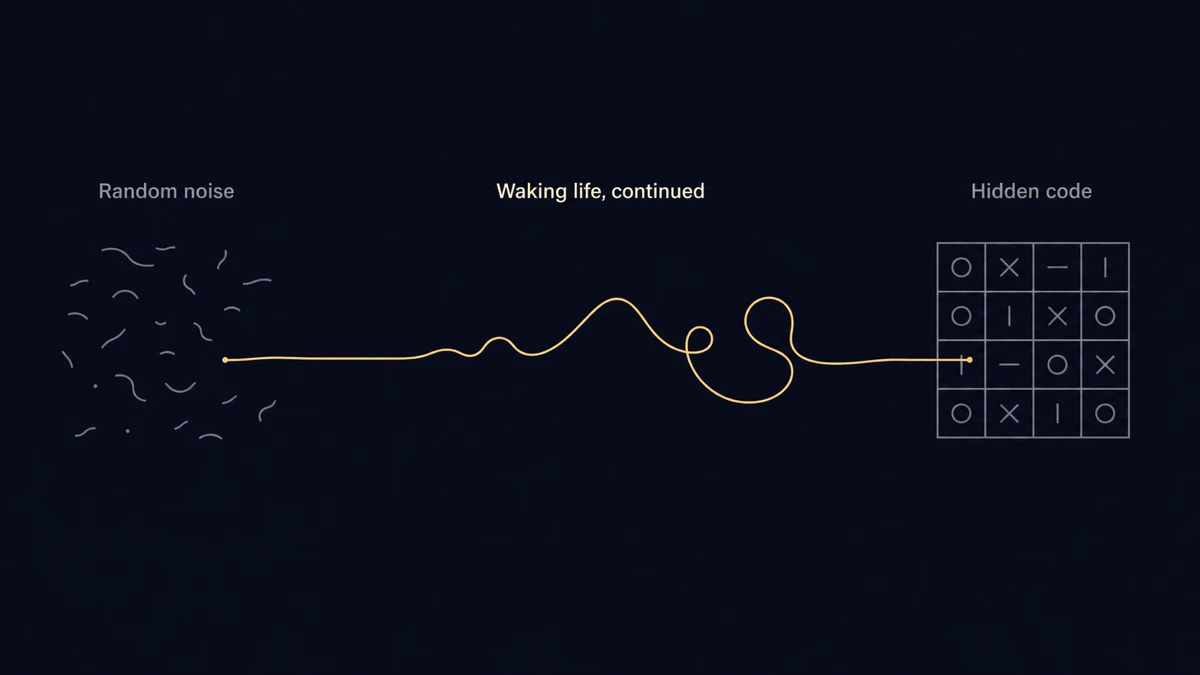
Yes, but not the way a dream dictionary claims. Decades of research point to a middle position: dreams aren’t random neural noise, and they aren’t coded prophecies. They continue your waking life, with its concerns, people, and unfinished feelings. So a dream means something specific to you, and nothing fixed to anyone else.
That’s the short answer. The longer one is more interesting, because the two loudest answers to this question are both wrong, and the truth sits quietly between them.
| The answer | What it claims | What the research says |
|---|---|---|
| Random noise | Dreams are a story stitched over meaningless brain signals | The spark may be random, but the material comes from your life |
| Hidden code | Every symbol stands for a fixed, decodable meaning | No universal key holds; content follows each person’s waking life |
| Continuity | Dreams carry your waking concerns into sleep, selectively | Best supported: dreams track what matters to you, weighted by feeling |
Are dreams just random noise from the brain?
This is the first loud answer: dreams mean nothing because they are nothing, just a byproduct of a brain idling through the night. It has a real scientific pedigree. In 1977, the Harvard psychiatrists J. Allan Hobson and Robert McCarley proposed the activation-synthesis hypothesis. During REM sleep, they argued, the brainstem fires more or less at random, and the higher brain does what it always does with incoming signal: it makes a story. On this view the dream is the synthesis, an after-the-fact narrative stitched over noise, and the noise had no message to begin with.
It’s a bracing idea, and it did real damage to the notion that every dream is a telegram from the unconscious. But notice what it doesn’t establish. Even if the spark is random, the material the mind reaches for to build the story is not. It’s your memories, your faces, your unfinished Tuesday. Random ignition, meaningful fuel. A struck match is random too; what it catches is not.
Are dreams coded messages you have to decode?
The second loud answer is the older one, and far more popular. It runs from Freud’s The Interpretation of Dreams straight through to the dream dictionary on the bookshop shelf: every dream is a disguised message, and the job is to decode it, symbol by symbol.
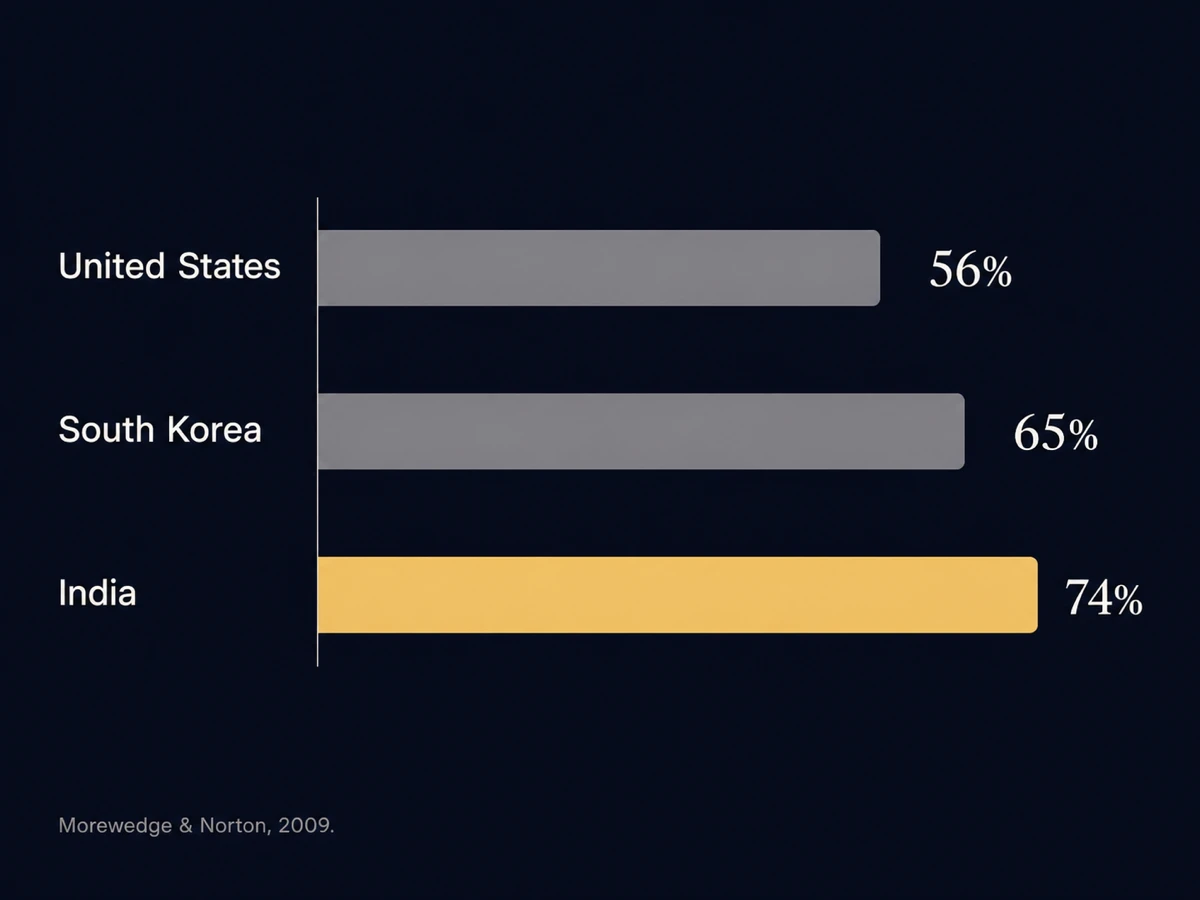
The belief is not fringe. In a 2009 study across cultures, Carey Morewedge and Michael Norton found that 56% of people in the United States, 65% in South Korea, and 74% in India endorsed the view that dreams reveal hidden truths about the world. People also weighted dreams as more meaningful than comparable waking thoughts, especially when the dream fit what they already wanted to believe. The instinct that a dream means something is close to universal.
A universal instinct, though, is not a universal key. The trouble with the dictionary is not that dreams are meaningless. It’s that dream content follows your particular waking life too closely for one fixed list to fit everyone. This is the continuity hypothesis, and it’s one of the best-supported findings in the field. Across the tens of thousands of dream reports coded in the Hall/Van de Castle tradition and catalogued in Domhoff’s dream databases, what people dream about maps onto what occupies them awake: the people they see, the work they carry, the emotions they’re working through. The map holds for closed chapters too. Even the ex from years ago turns up in the record, still timed to whatever the dreamer’s weeks are doing. A snake in your dream and a snake in mine arrive on different weeks, from different lives. No entry in a book can hold both.
Do dreams replay your day exactly?
No, and this detail matters more than it looks. Continuity is selective. In a 2003 diary study, Michael Schredl and Frank Hofmann measured how people actually spent their waking hours and compared it with what showed up in their dreams. Some activities carried over readily. Highly focused ones, such as reading and writing, rarely appeared at all, even for people who spent much of the day doing them. The authors concluded that the continuity hypothesis needs refining, with factors like the type of experience and emotional involvement deciding what makes it into a dream.
That is the strongest argument against the dictionary, and it cuts the other way from what you might expect. Dreams don’t take in your day evenly. They seem to keep what you feel about, not simply what you spent hours on. Which is why the same image can carry so much in one week and nothing in another: the weight comes from you. What dreaming is for is a separate argument, covering memory filing, emotional housekeeping, and threat rehearsal, surveyed in why we dream.
What does the research actually say dreams do?
Here is the middle, and it’s where the honest answer lives. Dreams aren’t noise and they aren’t code. They’re the visible surface of the brain doing overnight work on your waking experience.
Two lines of research anchor this. The first is the continuity hypothesis above: dream content reflects waking concern, which is exactly why dreams feel meaningful. They are made of your life. The second is what that reflection might be for. In a 2010 study in Current Biology, Erin Wamsley and colleagues had 99 people learn a virtual maze, then either nap or stay awake before a retest. Only 4 of the 50 nappers reported dreaming about the maze, and those four improved roughly tenfold more at retest than the other nappers. They had started out among the weakest performers, and the advantage held even after the researchers accounted for that.
Read that finding carefully, because the researchers did. They do not claim the dream caused the improvement, and four people is a small group. The cleaner interpretation is that dreaming of the maze was a sign that the sleeping brain was busy consolidating it: the dream as a readout of memory processing, not its engine. Either way, the dream was about something real and doing something real. That is a long way from meaningless static, and a long way from a secret you have to crack. The meaning is continuity, not code.
So do dreams mean anything about the future?
No. This is where the honest answer has to be blunt: there is no evidence that dreams predict events, and nothing in the science above hints otherwise. Dreams are about your present and your past, the day’s residue and the year’s worry, not a preview of what’s coming.
The feeling that a dream “came true” is real, but it has a plainer source than prophecy: probability plus memory. You dream every night, several times a night, and forget almost all of it by breakfast. Across a lifetime that adds up to an enormous number of dreams about an enormous range of things. When one happens to rhyme with a later event, it lands hard and you remember it, while the thousands that matched nothing dissolve without a trace. The hits get counted; the misses don’t. That’s not a message from the future. It’s what large numbers do.
How do you find what a dream means for you?
If the meaning is continuity with your life, then the method follows. You don’t look a dream up. You run the comparison a dictionary can’t: your dream against your own history, over time.
- Date it. Record the dream on waking, before it fades: what happened, how it felt, who was in it. The window is short; the first minute of waking is where a dream is either kept or overwritten.
- Note the week, not just the night. What was being decided, feared, or grieved around that date? Continuity means the dream is commenting on something in range.
- Notice the feeling first. Because dreams keep what carries emotional weight, the mood of the dream is often a better clue than its props. Anxious, relieved, embarrassed: start there.
- Watch for what recurs. One dream is weather. The same image landing in the same kind of week is a recurring dream, and the pattern is data, yours rather than the species’.
- Read the pattern against your life, not a list. A dream about your teeth falling out means one thing in a month of being judged and another in a month of grinding your jaw. The record tells you which; the dictionary can’t.
This is the whole quiet argument for keeping a dream journal: a single dream invites guessing, but a dated stack of them invites reading. It’s also the argument for capturing the dream the fastest way there is, which is speaking it, eyes closed, in the dark, before the echo goes. That’s the ritual Dreamsay is built around, and the transcription happens entirely on your phone. Your voice never leaves your device.
So, do dreams mean anything? They mean quite a lot, just none of it fixed in advance and none of it printed in a book. The meaning is the one you’ve been assembling, unknowingly, one night at a time. The only place to look it up is your own history.
Common questions
Do dreams have hidden meanings?
Meaning yes, hidden code no. The belief that dreams reveal concealed truths is common across cultures; a 2009 study found most people in the US, South Korea, and India endorse it. But dream content tracks your waking life too closely for a universal symbol key to work. The meaning is personal, not encrypted.
Are dreams random or meaningful?
Both, at different stages. The activation-synthesis hypothesis holds that dreams start from random signals in the sleeping brainstem. But the story your mind builds from that noise draws on your actual memories and concerns. The ignition can be random while the material is meaningful.
Can dreams predict the future?
No evidence supports it. Dreams do not forecast events. When a dream seems to come true, the likeliest explanation is probability plus memory bias: you dream every night, forget almost all of it, and remember the rare hit while the thousands of misses vanish unremarked.
Do dream dictionaries actually work?
There is no universal symbol key. Dream content follows each person's waking life, so the same image turns up in different situations for different people, and a fixed list of meanings can't hold. A dated journal of your own dreams does better than any dictionary, because it reads you rather than an average.
What do scientists think dreams are for?
Leading theories point to memory consolidation and emotional processing. In a 2010 study, the few nappers who dreamed about a maze task improved about ten times more at retest than other nappers. That is an association, not proven cause, and researchers read the dream as a sign of the brain's overnight memory work.
Sources
- Morewedge & Norton (2009), When Dreaming Is Believing: The (Motivated) Interpretation of Dreams, Journal of Personality and Social Psychology 96(2), 249–264
- Wamsley, Tucker, Payne, Benavides & Stickgold (2010), Dreaming of a Learning Task Is Associated with Enhanced Sleep-Dependent Memory Consolidation, Current Biology 20(9), 850–855
- Schredl & Hofmann (2003), Continuity between waking activities and dream activities, Consciousness and Cognition 12(2), 298–308
- Hobson & McCarley (1977), The Brain as a Dream State Generator: An Activation-Synthesis Hypothesis of the Dream Process, American Journal of Psychiatry 134(12), 1335–1348
- The Quantitative Study of Dreams: Hall/Van de Castle dream content norms (Domhoff, UC Santa Cruz)
Keep reading
What does it mean to dream about water?
Water dreams are rarely one symbol. What research says about swimming, floods, and tidal waves, the readings that recur across cultures, and how to find yours.
What does it mean to dream about someone dying?
Death dreams are common and rarely about death itself. What the research says, why dreams of the dead are usually comforting, and how to find what yours means.
Why did I dream about my ex?
Dreams about an ex are common, sometimes years later. What the research actually says, the readings that recur, and how to find what yours is about.
Dreamsay readings — and these notes — are for entertainment and personal reflection, not medical or psychological advice.