Why do we dream?
By Nora Bennett ·
Nora Bennett writes Notes on dreaming, the Dreamsay journal on dream science, recall, and what your own history can tell you that a dictionary can't.
No one has proven why we dream, and the honest answer is that several explanations currently compete. The leading theories assign dreaming a role in storing memories, resetting emotions, and rehearsing threats. What they all agree on: dreams are built from your waking life, which is why they track your concerns so closely.
That’s the short answer. The longer one is more interesting, because each theory comes with dated evidence you can weigh, and the disagreement between them has been running, in one form or another, for a full century of sleep research.
What happens in the brain when you dream?
You know the setup from the inside: the corridor that isn’t yours but is completely convincing, the certainty of being late, the running that doesn’t move. Underneath, a specific physiology is running. Sleep cycles through stages several times a night, and in the rapid-eye-movement (REM) stage the brain does something remarkable: visual and emotional centers operate close to waking levels, while the prefrontal machinery that handles logic, self-monitoring, and reality-checking idles. Most voluntary muscles are switched off at the same time, which is why a mind that wakes a moment too early can find itself in sleep paralysis. The dream is generated by the same networks that generate waking perception, minus the critic. That is why it feels first-hand, and why the absurd passes without comment.
This is also where the first modern theory of dreaming’s purpose entered the literature. In 1977, the Harvard psychiatrists J. Allan Hobson and Robert McCarley proposed activation-synthesis: during REM sleep, signals fire up from the brainstem more or less at random, and the cortex does what it always does with incoming signal, it synthesizes a story. On this account, dreaming carries no message; it is the byproduct of a brain making sense of noise.
The strong version, the one that concluded dreams are meaningless, did not survive. What did survive is subtler: the ignition can be random while the material is anything but. The honest answer to whether dreams mean anything sits exactly there, and each theory below is, in its own way, an account of what the brain reaches for when it builds the story.
Is dreaming the brain filing its memories?
The memory account starts from work sleep is known to do. Overnight, the brain replays and consolidates what the day delivered, moving fresh experience toward long-term storage; dreaming, on this view, is the visible surface of that filing. You don’t see the database. Occasionally you see the drive light.
The most striking evidence for processing-without-awareness came from a computer game. In 2000, Robert Stickgold and colleagues had people play Tetris and collected reports at sleep onset, the drowsy threshold between waking and sleep. Participants reported intrusive, stereotyped images of falling blocks. The strange part: three amnesic patients, unable to recall having played the game at all, produced the same images anyway. The night shift kept processing material its owner could no longer access. Some participants even reported images from versions of Tetris they had played years earlier, remote memories bleeding into the night’s fresh footage.
If dreaming is part of overnight filing, it explains a companion finding: the dream itself is rarely kept. REM chemistry is hostile to memory storage, and there is evidence of an active forgetting signal that sweeps the night’s material. You watch the processing happen and lose it by breakfast, which is why catching a dream in the first minute of waking matters more than any theory about what it was doing.
Do dreams manage your emotions?
The emotional account begins with what a night without sleep does to you. In 2007, Seung-Schik Yoo, Matthew Walker, and colleagues scanned people looking at aversive images, some after a normal night’s sleep and some after roughly thirty-five hours awake. In the sleep-deprived group, the amygdala, the brain’s alarm center, reacted about 60% more strongly, and the prefrontal cortex that normally regulates it had lost its grip on the response. Sleep, the authors concluded, restores next-day emotional control.
The dreaming extension of this work proposes that REM sleep is when that resetting happens: the brain re-runs the day’s charged material in a neurochemical state that keeps the memory but retires much of the alarm. It is a picture of the night as maintenance. Yesterday’s argument gets replayed at lower volume until it stops being an emergency.
Read descriptively, this fits what dreams are made of. Emotion runs dense in REM dreaming, and the coded dream reports of the last several decades keep finding the same law: the dream’s subject is the dreamer’s current concern. Even this theory ends in continuity. The dream works on your material, which means the material stays legible in the dream.
Are dreams rehearsals for danger?
The evolutionary account notices what dream content is full of. In 2000, the cognitive neuroscientist Antti Revonsuo surveyed the evidence and proposed threat simulation theory: the biological function of dreaming is to simulate threatening events, and to rehearse perceiving and avoiding them. His supporting pattern is content-based. Dreams are organized, not random, and they overrepresent the dangerous, from aggression to pursuit; the skew shows up in children’s dreams, in recurrent dreams, and in nightmares, which is where a rehearsal system would predict it. For a species whose ancestors’ nights featured considerably more teeth than ours, a threat simulator would have earned its keep.
The survey data rhyme with the theory. In the largest typical-dreams study on record, 1,181 university students were asked in 2003 which of 55 common themes they had ever dreamed: being chased topped the list, reported by 81.5% of them, ahead of sexual experiences at 76.5% and falling at 73.8%. Whatever a chase dream is about in your life (something gaining on you is the reading that recurs), it is a dream nearly everyone has had, which is what you would expect of a system that spends its nights rehearsing avoidance.
Threat simulation has honest critics: dreams are also full of errands and empty supermarkets, and the theory has to explain the mundane away. It remains one of the live candidates, not a verdict.
Can dreams solve problems?
A narrower claim, with unusually clean evidence: REM sleep helps with creative association. In 2009, Denise Cai, Sara Mednick, and colleagues gave people the Remote Associates Test, word puzzles solved by finding a fourth word that links three, then let some of them nap. The people who reached REM improved by almost 40% on the puzzles whose elements they had seen earlier that morning. Quiet rest produced no improvement; non-REM naps produced none; better memory for the puzzles predicted none of the gain. REM, the authors concluded, integrates unassociated information.
That result is about naps and word puzzles, not midnight revelations, and it doesn’t promise that your dream will hand you the answer. What it supports is smaller and stranger: the dreaming state is good at connecting things you hadn’t connected, which may be why a problem can look different after sleep than before it.
Which theory is right?
Honestly, none has won. Dream science still treats dreaming’s function as an open question, and the most cited caution comes from the dream researcher G. William Domhoff, whose laboratory’s position is that no adaptive function has been demonstrated: dreams may be something like a nightly byproduct that nevertheless, reliably, means, because they express the dreamer’s conceptions and concerns, measurable across tens of thousands of coded reports.
| Theory | Proposed | Core claim | Strongest evidence so far |
|---|---|---|---|
| Activation-synthesis | 1977 | Random REM signals; the cortex builds a story | REM physiology; the “meaningless” half has not held |
| Memory consolidation | 2000 | Dreaming is the readout of the night’s filing | Sleep-onset images of Tetris, even in amnesics (2000) |
| Threat simulation | 2000 | Dreams rehearse perceiving and avoiding threats | Threat-heavy skew in children’s, recurrent, and nightmare content |
| Emotional regulation | 2007 | REM sleep resets emotional reactivity overnight | 60% amygdala overreaction after sleep loss, reversed by sleep |
| Overfitted brain | 2021 | Dream noise keeps the brain from overfitting to the day | A recent hypothesis; suggestive, not yet tested |
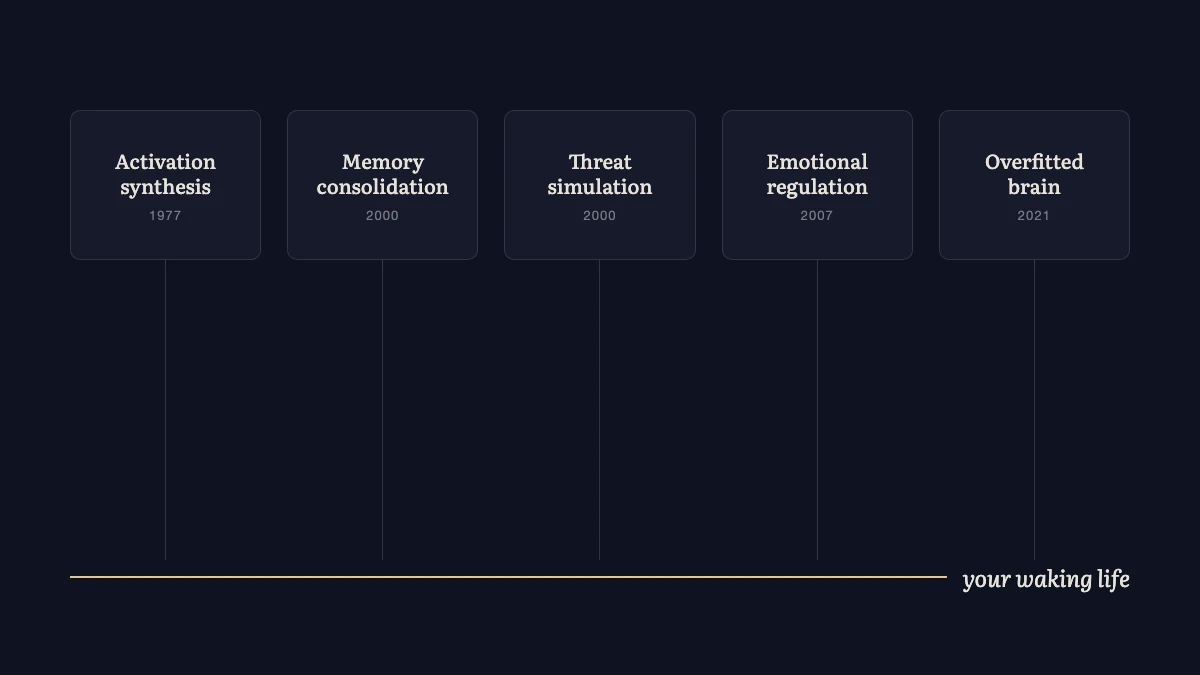
The newest entrant has the most contemporary flavor. In 2021, the writer and researcher Erik Hoel proposed the overfitted brain hypothesis: dreams as the neural version of the noise that data scientists deliberately inject so their models stop memorizing examples and start generalizing. A brain that replayed its days exactly would overfit to them; dreams scramble the material, on this account, precisely so it stays useful. The idea is young and untested, and that is worth noticing in itself: the field is still producing new function theories, not closing them out.
What every serious account shares is quieter than any of them: the material. Random ignition, meaningful fuel; filing, rehearsal, emotional maintenance, noise injection; each theory runs on what your days delivered. That convergence is the best-supported finding in dream science, the continuity hypothesis, and it is the one finding with a method attached.
Why do we dream about what we dream about?
Because the dreaming brain takes your days seriously. Sleep researchers call it day residue: whatever waking life served up, the night processes. This is why the same image can carry such different weight in different lives, and why the only reading that holds up over time is the one checked against your own record.
- Date it. Record the dream at waking, before it goes. The window is about a minute wide, and speaking beats typing for getting a dream down inside it.
- Note the week, not just the night. Every theory above predicts the dream sits in range of your concerns; the date is how you test that.
- Watch what recurs. Repetition is signal. Recurring dreams mark the material the night keeps returning to.
- Read the pattern, not a dictionary. One dream is weather. A dated stack is a climate record, and it is the only text the theories above can actually be checked against.
That is also the quiet case for a dream journal of any kind, and it is why Dreamsay exists in the form it does: you speak the dream the moment your eyes open, and the transcription happens on the phone in your hand. Your voice never leaves your device.
Why do we dream? The honest verdict is that the night brain appears to be doing several plausible kinds of work, and it has not confessed to which one it is for. The material has never been the mystery. It is your life, filed, rehearsed, and re-run, one night at a time. What your dreams keep choosing out of it is the part you can still go and read.
Common questions
What is the purpose of dreaming?
No single purpose has been proven. The leading theories propose that dreaming supports memory consolidation, overnight emotional recovery, and rehearsal of threats, and a 2021 proposal casts dreams as noise that keeps the brain from generalizing badly. Every serious theory shares one core: dream content is drawn from your waking life.
Why do dreams feel so real?
During REM sleep the visual and emotional systems run near waking levels while the prefrontal machinery that checks reality idles. The dream is generated by the same networks that produce waking perception, with the usual critic off duty, so absurd events pass unremarked and the experience feels first-hand.
Why do we dream about people from our past?
Dream content tracks waking life, and people from your past stay in memory whether or not they appear in your days. Continuity research finds dreams returning to active concerns, including chapters long closed. In bereavement surveys, majorities of the bereaved report dreams of the person who died, most often experienced as comforting.
Do dreams help you solve problems?
There is dated support for one narrow version. In a 2009 study, people who napped into REM improved by almost 40% on word puzzles they had been primed with that morning, while quiet rest and non-REM naps produced no improvement. REM appears to help integrate unassociated information, not to deliver answers.
Are dreams just random brain activity?
The ignition can be. Activation-synthesis holds that signals fire semi-randomly from the brainstem during REM sleep and the cortex builds a story from them. But the material of the story is not random: it is your memories and current concerns, which is why dreams track your life closely enough to read.
Sources
- Hobson & McCarley (1977), The Brain as a Dream State Generator: An Activation-Synthesis Hypothesis of the Dream Process, American Journal of Psychiatry 134(12), 1335-1348
- Stickgold, Malia, Maguire, Roddenberry & O'Connor (2000), Replaying the Game: Hypnagogic Images in Normals and Amnesics, Science 290(5490), 350-353
- Revonsuo (2000), The Reinterpretation of Dreams: An Evolutionary Hypothesis of the Function of Dreaming, Behavioral and Brain Sciences 23(6), 877-901
- Nielsen, Zadra, Simard, Saucier, Stenstrom, Smith & Kuiken (2003), The Typical Dreams of Canadian University Students, Dreaming 13(4), 211-235
- Yoo, Gujar, Hu, Jolesz & Walker (2007), The Human Emotional Brain Without Sleep: A Prefrontal Amygdala Disconnect, Current Biology 17(20), R877-R878
- Cai, Mednick, Harrison, Kanady & Mednick (2009), REM, Not Incubation, Improves Creativity by Priming Associative Networks, Proceedings of the National Academy of Sciences 106(25), 10130-10134
- Hoel (2021), The Overfitted Brain: Dreams Evolved to Assist Generalization, Patterns 2(5), 100244
- The Quantitative Study of Dreams, Hall/Van de Castle dream content norms (Domhoff, UC Santa Cruz)
Keep reading
What does it mean to dream about water?
Water dreams are rarely one symbol. What research says about swimming, floods, and tidal waves, the readings that recur across cultures, and how to find yours.
What does it mean to dream about someone dying?
Death dreams are common and rarely about death itself. What the research says, why dreams of the dead are usually comforting, and how to find what yours means.
Why did I dream about my ex?
Dreams about an ex are common, sometimes years later. What the research actually says, the readings that recur, and how to find what yours is about.
Dreamsay readings — and these notes — are for entertainment and personal reflection, not medical or psychological advice.