What is sleep paralysis?
By Nora Bennett ·
Nora Bennett writes Notes on dreaming, the Dreamsay journal on dream science, recall, and what your own history can tell you that a dictionary can't.
Sleep paralysis is the brief experience of waking up unable to move or speak. Your mind has surfaced from REM sleep, but the muscle paralysis that keeps you from acting out dreams is still switched on. Often it brings a sensed presence, pressure on the chest, or a figure in the room, and it passes on its own.
That’s the short answer. The longer one is more interesting, because the figure in the room has been reported, painted, named, and argued over for centuries, and the science that finally explained it explains the visitor too.
What is happening in your body during sleep paralysis?
You know the scene if you’ve had it. Your eyes are open. The room is your room: the wardrobe, the light under the door, the shape of the chair. You decide to sit up, and nothing happens. The decision goes out and the body declines to receive it.
What has happened is that two states are running at once. Every night, during REM sleep (the stage of long, vivid dreams), the brain switches off most voluntary muscles. It is the same built-in paralysis that turns your legs to sand when you try to run in a chase dream. In 2012, Patricia Brooks and John Peever showed how thorough the switch is, working with the jaw muscles of rats: a combined GABA and glycine drive silences the motor neurons, and the paralysis lifted only when every one of those inhibitory routes was blocked at once. It is not a dimmer. It is a lock with several keys.
Normally the lock releases before you notice it was ever closed. In sleep paralysis, awareness returns first. The waking mind arrives in a body that is still, for the moment, in REM.
The cleanest look at that overlap comes from a sleep laboratory in Japan. In 1992, Takeuchi and colleagues deliberately interrupted the sleep of 16 volunteers across four experimental nights, waking them at a set point after a REM period and keeping them up for an hour. When the volunteers went back to sleep, they often dropped straight into REM, and six of the interruptions produced an episode of sleep paralysis on the recording. Every one of those sleepers reported being unable to move while knowing they were lying in the lab. The instruments agreed with them: the brain showed the alpha rhythm of quiet wakefulness, while the muscle signal stayed flat in REM’s paralysis.
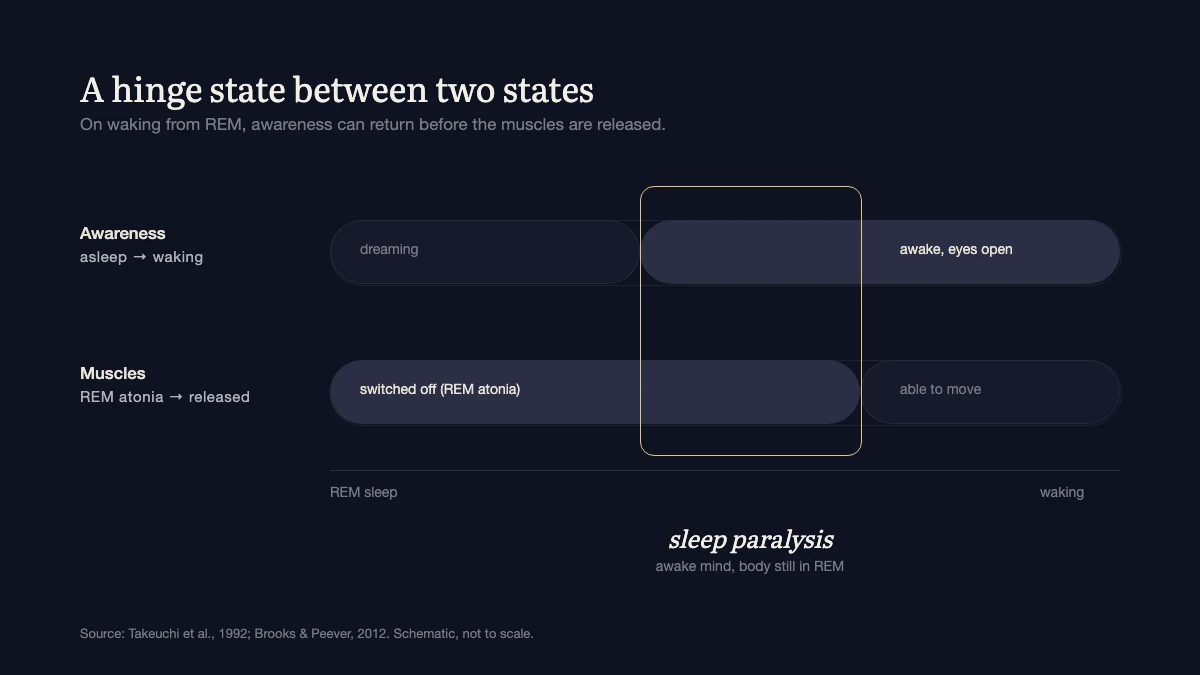
So the honest description is not “a dream” and not “awake”. It is a hinge state, a few moments in which the REM physiology behind dreaming has not finished handing over to the day.
How common is sleep paralysis?
More common than almost anyone who has had it assumes. The fear arrives with a sense of private strangeness, and the numbers do not support the private part.
| Group | Had at least one episode | Source |
|---|---|---|
| General population (35 studies, 36,533 people) | 7.6% | Sharpless & Barber, 2011 |
| Students (same review) | 28.3% | Sharpless & Barber, 2011 |
| Japanese college students (635 surveyed) | about 40% | Fukuda et al., 1987 |
The 2011 review by Brian Sharpless and Jacques Barber is the standard reference: it pooled every study that reported lifetime rates and described both its method and its sample. Roughly one person in thirteen has had at least one episode, and among students, whose sleep is famously irregular, it is more than one in four.
There is also a family component. In 2015, Dan Denis and colleagues studied 862 young adult twins and siblings in England and Wales and estimated the genetic influence on sleep paralysis at 53%. That is moderate, not destiny. It means the hinge is looser in some people than in others.
You are not haunted. You are in a well-populated minority.
Why do people see a figure in the room?
Because the brain arrives with dream machinery still running, and the dream has a real room to project into.
The most useful map of what people see comes from J. Allan Cheyne and colleagues, who in 1999 analyzed reports from several large samples and found that the experiences fall into three clusters:
- The intruder. A sensed presence, often before anything is seen, along with fear, sounds, and shapes at the edge of vision. Cheyne’s team proposed it begins as a hypervigilant state in the midbrain: a threat detector switched on, with nothing to detect, filling the gap.
- The incubus. Pressure on the chest, difficulty breathing, sometimes pain. The researchers tied this to the paralysis itself and to how it alters the felt sense of breathing. The chest is not being pressed on. It is reporting, unusually loudly, that it cannot be moved.
- Unusual bodily experiences. Floating, flying, the sense of leaving the body, and, less famously, feelings of bliss. Not every episode is a horror film.
The first two have something in common, Cheyne noted: both imply an other. A presence that watches, a weight that presses. Put them together in a dark room at 4 a.m., and the mind does what it always does with ambiguous signal. It supplies a someone.
Why does every culture have a name for it?
Because the experience is the same everywhere and the someone is local. Wherever researchers ask, they find the hinge state, and they find a tradition that has already given the visitor a face.
| Where | The visitor | What researchers found |
|---|---|---|
| Japan | Kanashibari, being bound as if by metal | About 40% of 635 college students had experienced it (Fukuda et al., 1987) |
| Egypt | The jinn | 48% of a general-population sample believed the jinn caused their episodes (Jalal et al., 2014) |
| Denmark | The study’s comparison group | Participants were less likely than Egyptians to give a supernatural explanation (Jalal et al., 2014) |
| Abruzzo, Italy | The Pandafeche, an evil witch, a ghost-like spirit, or a humanoid cat | 38% thought it might have caused their episode; 24% sensed it in the room (Jalal et al., 2015) |
| England | The mare of “nightmare”, a spirit that sat on the sleeper | The image behind Henry Fuseli’s 1781 painting The Nightmare, a creature crouched on a sleeping woman’s chest |
The Egyptian comparison is the instructive one. Baland Jalal and colleagues found that education shifted the explanation: students at the American University in Cairo were less likely than the general Egyptian population to blame the supernatural, and Danes less likely still. The paralysis did not change between Cairo and Copenhagen. The interpretation did.
This is the same argument the rest of this journal makes about dreams that come back. The mechanism is shared by the species. What it means, and what it looks like, comes from the history of the person it happens to.
What makes sleep paralysis more likely?
Researchers have found several reliable associations. They are findings about who reports episodes and when, not a recipe, and the picture they draw is mostly one of disrupted sleep.
- Sleeping on your back. In 2002, Cheyne surveyed 6,730 people, 4,699 of whom had experienced sleep paralysis. More of them reported episodes on their back than in all other positions combined, and the supine position was three to four times more common during an episode than when they ordinarily fell asleep.
- A disturbed sleep-wake cycle. In the 1987 Japanese survey, about half of those with episodes said they had been under physical or psychological strain, or keeping irregular hours, just before one.
- Broken sleep. The 1992 laboratory study produced episodes simply by interrupting sleep at the wrong moment and letting the sleeper drop back into REM.
- Hard stretches of life. In the 2015 twin study, poorer general sleep quality and exposure to threatening events were each associated with sleep paralysis on their own.
One local detail is worth keeping. Among the traditional protections against the Pandafeche recorded in Abruzzo was sleeping on your back. Folk wisdom is not always on the side of the data.
Is sleep paralysis a dream?
Partly, which is what makes it so convincing. A dream happens with the world switched off; you are fully inside it, and nothing contradicts it. Sleep paralysis happens with the world switched back on. The room is real and correctly furnished, and the dream’s imagery is laid over it. A shape in the real doorway is far more persuasive than a shape in a dreamed one. It is also why sleep paralysis is so often mistaken for a nightmare, which ends with the waking rather than beginning there.
It belongs to a small family of threshold events. The hypnic jerk is the body’s misfire on the way into sleep, a twitch in its first seconds. Sleep paralysis is its mirror on the way out of REM: the mind leaves early and the body stays behind. Neither is a dream exactly. Both are what you notice when the handover between states is slightly out of step.
What did yours look like?
Here is the part the research can’t do for you. Cheyne can tell you why there is a presence; Jalal can tell you why it might be a jinn in Cairo and a witch in Abruzzo. Neither can tell you why yours wore that coat, stood in that corner, or arrived in that particular week.
Those details are yours, and like any dream content they are worth keeping. Date the episode. Note what the visitor was, what the room did, how long the body took to come back, and what the surrounding days were like. One episode is an anecdote. Five dated ones become a pattern that belongs to you rather than to the species: the same kind of week, the same hour, the same figure.
Recording matters because these episodes fade like any dream lost by breakfast. Speaking the account in the minute after your body comes back is the fastest way to keep it, which is the design brief behind a voice-first journal like Dreamsay: the recording is transcribed on the phone in your hand. Your voice never leaves your device. A notebook works too. What matters is that a record exists, because the visitor only becomes readable over time.
When is it more than a dream?
If episodes arrive often enough to wear down your sleep, that is a waking-life matter worth raising with a doctor. The episode was the messenger, not the problem. For everything else, sleep paralysis is what it has been since long before anyone painted it: a few moments of being awake in the wrong order, with the oldest visitor in the human imagination standing in your own doorway.
Common questions
How common is sleep paralysis?
Common enough to be ordinary. A 2011 systematic review pooled 35 studies covering 36,533 people and found that 7.6% of the general population had experienced at least one episode, rising to 28.3% among students. Single samples can run higher: about 40% of Japanese college students in a 1987 survey.
Why do you feel a presence or pressure on your chest during sleep paralysis?
These experiences cluster in predictable ways. A 1999 analysis grouped them into an intruder pattern (a sensed presence, fear, sounds, shapes) and an incubus pattern of chest pressure and labored breathing, which the researchers linked to how REM paralysis alters the feeling of breathing. Both come from the sleeping brain, not the room.
Why does sleep paralysis happen when you sleep on your back?
The exact reason is unsettled, but the association is strong. In a 2002 study of 6,730 people, more reported sleep paralysis on their back than in all other positions combined, and lying supine was three to four times more common during episodes than when ordinarily falling asleep. Brief arousals out of REM may play a part.
Is sleep paralysis the same as a nightmare?
No. A nightmare happens inside a dream, and you wake from it. Sleep paralysis happens after the waking: you know you are in your bedroom, but the muscle paralysis of REM sleep has not yet released. Lab recordings show it as a mixed state, waking brain rhythms alongside muscles still switched off.
Why do different cultures see different creatures during sleep paralysis?
Because the experience is shared and the explanation is borrowed from local tradition. In Japan it is kanashibari; in a 2014 Egyptian sample, 48% blamed the jinn; in Abruzzo, Italy, 38% suspected a witch-like being called the Pandafeche. Danish participants were less likely to reach for the supernatural. The body supplies the visitor; culture supplies its face.
Sources
- Sharpless & Barber (2011), Lifetime prevalence rates of sleep paralysis: a systematic review, Sleep Medicine Reviews 15(5), 311-315
- Cheyne, Rueffer & Newby-Clark (1999), Hypnagogic and hypnopompic hallucinations during sleep paralysis: neurological and cultural construction of the night-mare, Consciousness and Cognition 8(3), 319-337
- Cheyne (2002), Situational factors affecting sleep paralysis and associated hallucinations: position and timing effects, Journal of Sleep Research 11(2), 169-177
- Brooks & Peever (2012), Identification of the transmitter and receptor mechanisms responsible for REM sleep paralysis, Journal of Neuroscience 32(29), 9785-9795
- Takeuchi, Miyasita, Sasaki, Inugami & Fukuda (1992), Isolated sleep paralysis elicited by sleep interruption, Sleep 15(3), 217-225
- Fukuda, Miyasita, Inugami & Ishihara (1987), High prevalence of isolated sleep paralysis: kanashibari phenomenon in Japan, Sleep 10(3), 279-286
- Denis, French, Rowe, Zavos, Nolan, Parsons & Gregory (2015), A twin and molecular genetics study of sleep paralysis and associated factors, Journal of Sleep Research 24(4), 438-446
- Jalal, Simons-Rudolph, Jalal & Hinton (2014), Explanations of sleep paralysis among Egyptian college students and the general population in Egypt and Denmark, Transcultural Psychiatry 51(2), 158-175
- Jalal, Romanelli & Hinton (2015), Cultural Explanations of Sleep Paralysis in Italy: The Pandafeche Attack and Associated Supernatural Beliefs, Culture, Medicine and Psychiatry 39(4), 651-664
Keep reading
Why do nightmares happen?
Nightmares come from the dreaming brain working through fear, mostly in late-night REM sleep. What the research says about why, and why they come in clusters.
What do recurring dreams mean?
Most people have a dream that keeps coming back. What research says recurring dreams are doing, why they cluster in hard seasons, and how to read yours.
What does it mean to dream about water?
Water dreams are rarely one symbol. What research says about swimming, floods, and tidal waves, the readings that recur across cultures, and how to find yours.
Dreamsay readings — and these notes — are for entertainment and personal reflection, not medical or psychological advice.