Why do I dream about falling?
By Nora Bennett ·
Nora Bennett writes Notes on dreaming, the Dreamsay journal on dream science, recall, and what your own history can tell you that a dictionary can't.
Dreaming that you’re falling is one of the most common dreams there is — around three in four people report it. Most of the time nothing is wrong: a falling sensation as you drift off is a harmless muscle twitch called a hypnic jerk, and a longer falling dream usually tracks whatever in your waking life feels like it’s slipping.
That’s the short answer. The longer one is more interesting, because “falling” turns out to be two different things wearing the same name.
How common is the falling dream?
Very. When researchers survey people about “typical dreams” — the themes that recur across whole populations — falling lands near the very top. In a 2003 study, Nielsen and colleagues gave the Typical Dreams Questionnaire to 1,181 first-year university students and found that 73.8% reported dreams of falling, making it the third most common theme, just behind being chased (81.5%) and sexual experiences. The profile barely shifted by age, gender, or region.
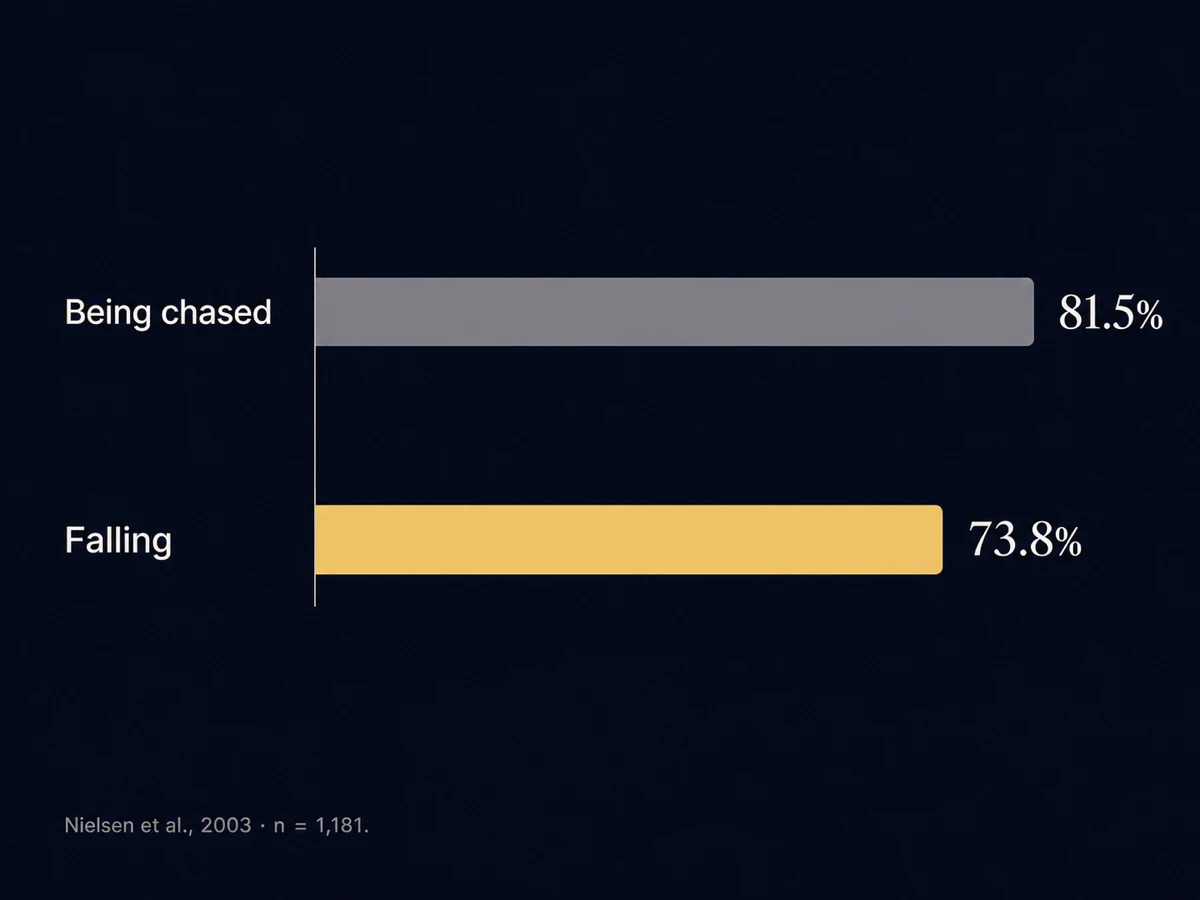
So whatever this dream is doing, it is not a private malfunction. In the Hall/Van de Castle tradition of dream-content research, which has coded tens of thousands of reports since the 1950s, falling shows up across ages, cultures, and continents — it sits in the same small cluster of near-universal themes as being chased, losing teeth, and turning up unprepared for an exam. Those are the dreams the whole species seems to keep having. You’re dreaming one of humanity’s standards.
Why do you feel like you’re falling as you drift off?
Here is the split. Some “falling dreams” aren’t dreams at all — they’re a jolt at the doorway of sleep.
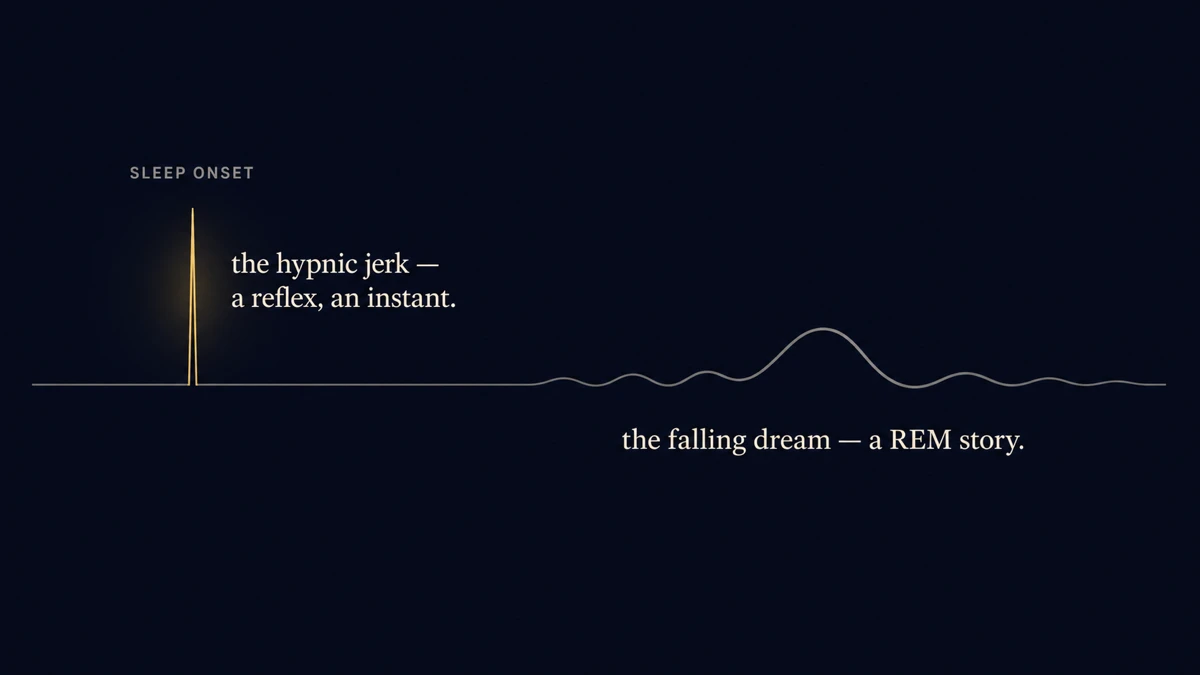
As you drift from waking into the first stage of sleep, your muscles are meant to relax by degrees. Sometimes the handoff misfires and the body fires a single sudden contraction instead: a hypnic jerk, also called a sleep start. It often arrives wrapped in a flash of imagery — most famously the sensation of missing a step or dropping through the floor — and it can jolt you fully awake, heart going, before you’ve dreamed anything at all. Up to 70% of adults experience these at some point, and sleep medicine files them under normal variants, not disorders. Researchers still don’t fully agree on the mechanism; the leading guess is a brief crossed signal in the brainstem as it switches modes. Caffeine, fatigue, stress, and late exercise all make them more likely. Its mirror image on the way out of REM is sleep paralysis, when the mind wakes before the body does.
There’s a tidy evolutionary story people like to attach here — that the jerk is a leftover reflex from tree-dwelling primate ancestors catching themselves from a fall as muscles slackened. It’s a nice story, and it’s speculation; no one has shown it, and it’s the kind of claim that’s easy to believe precisely because it can’t be tested. File it under plausible-but-unproven, which is where most just-so explanations of the body belong.
This is worth separating cleanly from the other falling dream. The hypnic-jerk version happens in the first seconds of sleep and lasts an instant. A long, narrative falling dream — plunging off a cliff, an elevator giving way — happens later, in REM sleep, and has a story around it. The popular telling collapses the two (“you jerk because you dreamed you fell”), but they run on different clocks. One is a reflex at the threshold. The other is a dream doing what dreams do.
What are the common readings?
For the narrative kind, a handful of interpretations recur across traditions often enough to be worth laying out — not as verdicts, but as candidates to test against your own week.
Loss of control. Falling is the body’s plainest image of the ground going out from under you. Many readers of this dream connect it to stretches when something felt like it was slipping — a plan, a role, a situation drifting somewhere they didn’t choose.
Letting go. A quieter reading treats falling as surrender rather than danger — the dream that arrives when you finally stop gripping something, for better or worse.
Exposure or failure. Falling in front of others borrows the same social charge as showing up unprepared: the fear of dropping visibly, publicly, with people watching.
A threshold. Some traditions read falling as the moment before a change lands — the step off the edge you can feel coming but haven’t taken yet.
None of these is the meaning. They’re the recurring suspects.
Does a falling dream actually mean anything?
It can — just not the way a dictionary promises. The best-supported idea in dream research is the continuity hypothesis: dream content tends to track your waking concerns rather than encode secret messages. A falling dream during a month when your footing feels uncertain isn’t a coincidence to decode; it’s your ongoing life, restaged.
What a falling dream does not do is predict anything. Dreams are not omens, and no tradition of evidence supports them forecasting events. That includes the durable myth that hitting the ground in a falling dream will kill you in your sleep — plenty of people report landing and waking up fine, which is all it takes to retire the claim. The dream usually ends before impact because you wake, not because impact is forbidden.
So the honest position sits between the two lazy ones. Falling isn’t meaningless noise, and it isn’t a coded prophecy. It’s a common, vivid image that means something specific to you — which is exactly why a lookup table can’t hand it to you.
How do you find what falling means for you?
Skip the dream dictionary and run the comparison it can’t: your falling dream against your own life, across time.
- Date it. Note when the dream arrived, in as much detail as you can keep — where you fell from, whether you were pushed or stepped off, how it felt.
- Note the week, not just the night. What was being decided, risked, or lost around that date? Falling dreams are most legible against the days on either side of them.
- Wait for the second one. A single falling dream is weather. Two or three, each landing in the same kind of week, is a recurring dream — and that pattern is yours, not the species’.
- Rule out the physical. If the “falling” is really a jolt as you drop off, look at caffeine, sleep debt, and stress before you look for symbolism. The hypnic-jerk version answers to sleep hygiene, not meaning.
This is the quiet argument for keeping a dream journal of any kind: interpretation only gets honest when there’s a record. One falling dream invites guessing; ten dated ones invite reading. Dreamsay exists to make that record effortless — you speak the dream the moment you wake, while it’s still vivid, and it’s transcribed on the device in your hand. Your voice never leaves your phone. The method is the same with a notebook; the app just removes the part where you fumble for a pen in the dark.
When is it more than a dream?
If sleep starts arrive often enough to fragment your nights, or the jolts leave you anxious about falling asleep, that’s a waking-life matter for better sleep habits or a doctor — the sensation was the messenger, not the problem. For everything else, the falling dream is what it has always been: a strange, common, oddly durable image that rewards attention and resists prophecy. The ground never actually arrives. The week around the dream is where the meaning is.
Common questions
Why do I feel like I'm falling right as I fall asleep?
That's a hypnic jerk, also called a sleep start — a sudden involuntary muscle twitch at the moment you drift off, often paired with a brief sensation of falling. It's experienced by up to 70% of adults at some point and is entirely benign, classed by sleep medicine as a normal variant.
Do falling dreams mean something bad?
No evidence supports dreams predicting events. Falling is one of the most widely reported dream themes in the world, and researchers read it as a reflection of present life — a stretch that feels out of control or in transition — rather than a sign of what's coming. It's common, not ominous.
Is it true you die if you hit the ground in a falling dream?
No. That's folklore with nothing behind it. Plenty of people report hitting the ground in a dream and waking up perfectly fine, which is enough to retire the claim. The idea persists because a dream that ends before impact is easy to mistake for a rule about impact.
Why do I keep having falling dreams?
Recurrence usually means the dream's occasion keeps recurring. A repeating falling dream is worth dating: many people find it clusters around the same kind of week — a loss of footing at work, a decision going sideways, a run of poor sleep. The pattern tells you more than any single night.
Sources
Keep reading
What does it mean to dream about water?
Water dreams are rarely one symbol. What research says about swimming, floods, and tidal waves, the readings that recur across cultures, and how to find yours.
What does it mean to dream about someone dying?
Death dreams are common and rarely about death itself. What the research says, why dreams of the dead are usually comforting, and how to find what yours means.
Why did I dream about my ex?
Dreams about an ex are common, sometimes years later. What the research actually says, the readings that recur, and how to find what yours is about.
Dreamsay readings — and these notes — are for entertainment and personal reflection, not medical or psychological advice.