What does it mean to dream about being chased?
By Nora Bennett ·
Nora Bennett writes Notes on dreaming, the Dreamsay journal on dream science, recall, and what your own history can tell you that a dictionary can't.
Dreaming about being chased usually reads as avoidance — something in waking life you are keeping your distance from, gaining ground at night. It is also the most commonly reported dream theme ever measured: in the largest typical-dreams study, 81.5% of people had it, more than any other dream. What yours is about, no dictionary can tell you.
That’s the short answer. The longer one is more interesting, because the chase is the closest thing dream research has to a universal — counted across decades, continents, and languages, and sitting at the top of the list nearly everywhere anyone has looked.
How common are dreams about being chased?
More common than any other dream we know how to count. In 2003, Tore Nielsen, Antonio Zadra, and colleagues gave the Typical Dreams Questionnaire — a list of 55 dream themes — to 1,181 university students across three Canadian cities. One item topped the list: being chased or pursued, not physically injured, reported by 81.5% of everyone asked. Sexual experiences came second at 76.5%; falling came third at 73.8%. The chase beat them both — and teeth dreams, for all their fame, rank in the bottom half of the same list.
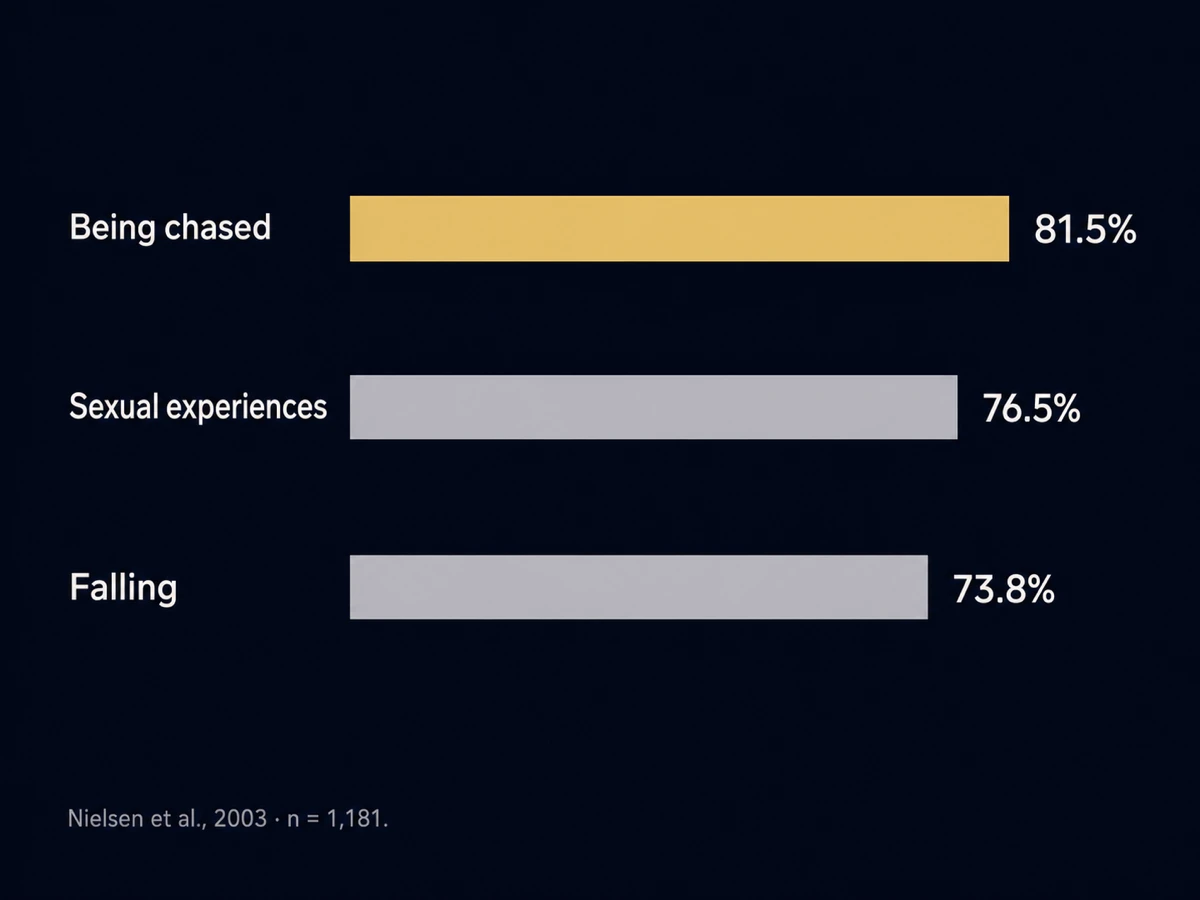
It goes deeper than prevalence. When the same students were asked which dream theme arrived earliest in their life, the chase won again — 21.6% named it their first remembered dream theme, more than any other, typically dating it to around age seven. For a remarkable number of people, the pursuit is where dreaming begins.
And it is not a modern habit. In 1958, Richard Griffith, Otoya Miyagi, and Akira Tago compared the typical dreams of American and Japanese students and found being attacked or pursued the most prevalent theme in both countries — same dream, both sides of the Pacific, half a century before the Canadian data said it again. Whatever the chase dream is doing, it is not a private malfunction and not a product of your particular news cycle. You’re dreaming humanity’s number one.
One detail from the 2003 study is worth pausing on: the questionnaire split pursuit without injury from attack with injury, and the second item ranked only twelfth, at 42.4%. The classic chase dream is not about being caught. It is about the gap — the distance between you and the thing behind you, held open all night.
Why does the sleeping brain stage a chase?
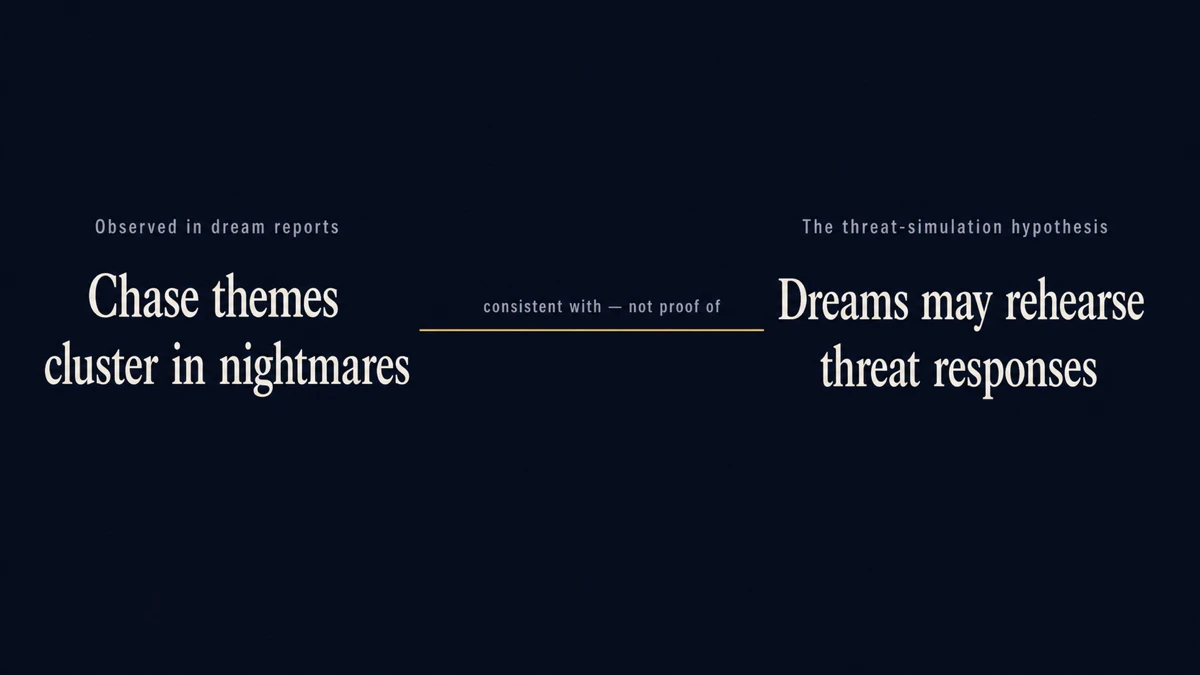
The most discussed answer comes from the Finnish researcher Antti Revonsuo, who argued in a 2000 paper that dreaming itself may be an evolved threat-simulation system: a nightly rehearsal space, built in ancestral environments where practicing escape had survival value, in which the brain runs realistic drills on the house’s own equipment. In that account the chase dream isn’t a glitch in the simulator. It is the flagship program.
The nightmare data sits comfortably alongside. In 2014, Geneviève Robert and Antonio Zadra reported that 572 adults logged 9,796 dreams over two to five weeks; from that collection, they analyzed 253 nightmares and 431 bad dreams reported by 331 participants — one of the largest prospectively recorded samples of disturbing dreams studied at the time. In the nightmares, physical aggression was the most frequent theme, with being chased and the presence of an evil force close behind. In everyday, unremarkable dreams, chase themes were essentially absent. The chase belongs almost entirely to the night’s alarm register: when the dreaming brain wants your attention, this is the story it reaches for first. Why that alarm goes off at all is the subject of why nightmares happen.
Honesty requires saying that threat simulation is a hypothesis, not a settled fact — rehearsal benefits are hard to measure, and researchers still argue about whether dreamed practice transfers to anything. What the theory gets undeniably right is the observation underneath it: the sleeping brain is conspicuously fond of staging threats, and conspicuously fond of this one.
What are the common readings?
Across traditions and a century of interpretive habit, a few readings recur often enough to lay out plainly — as candidates to test against your own life, never as verdicts.
Avoidance. The oldest and most durable reading: the chase as the shape of something you are not turning around to face. A conversation deferred, a decision postponed, an email aging in the inbox. By day you manage the distance; by night the distance runs on its own.
Something gaining ground. A close cousin, with a calendar attached. Deadlines, obligations, and consequences all move at a fixed speed, which is precisely the dread of the dream — you can sprint, and the thing behind you doesn’t need to.
Pressure with your name on it. Some readers connect the chase to being wanted, needed, or evaluated from too many directions at once — pursued less by a monster than by a queue.
A feeling in costume. The quietest reading treats the pursuer as an emotion that hasn’t been named yet — guilt, dread, longing — wearing whatever face the night props department had on hand.
Notice what stays constant and what doesn’t. The 1958 comparison found the pursuit itself on top in two very different cultures, but pursuers wear local costume: the figure chasing a student in Tokyo was not the figure chasing one in Kentucky, and neither is the figure chasing you. This is why the pursuer-identity dictionaries — stranger means this, animal means that — are the weakest way into the dream. The same figure means different things in different lives, and the dream’s engine was never the pursuer anyway. It was the pursuit.
Why can’t you run?
Because, in the most literal sense, you can’t. During REM sleep — the stage where vivid, narrative dreams live — the brainstem switches off most voluntary muscles, a built-in paralysis called REM atonia that keeps sleepers from acting out their dreams. Your legs are genuinely offline. Occasionally the switch outlasts the dream and you wake inside it, which is sleep paralysis. One plausible account of the mud-legged, slow-motion running so many people report is that the dream is incorporating the body’s actual state: the story calls for a sprint, the muscles decline to confirm, and the narrative papers over the disagreement with deep sand.
It is a strangely reassuring mechanism to know about. The helplessness in the dream’s worst moment is not a verdict on you. It is an engineering constraint.
How do you find what your chase dream means?
Not with a lookup table — with the comparison a dictionary can’t run: your dream against your life, across time.
- Date it. Get the dream down before it dissolves — pursuer, terrain, distance, how it ended. Speaking it is faster than writing it at 6 a.m., which is the entire design brief behind a voice-first journal like Dreamsay; however you record it, catch it in the first minute.
- Name the feeling, not the pursuer. Dread, guilt, urgency, embarrassment — the emotional signature is the dream’s most portable fact, and it survives even when the pursuer’s face doesn’t.
- Note the week, not just the night. What was gaining on you around that date? What were you keeping your distance from?
- Note what you did. Hid, fought, froze, turned around, flew. People who eventually turn to face the pursuer often report the dream changes — worth noticing if your chases are changing shape across a season.
- Wait for the second one. A single chase dream is weather. Two or three, each landing in the same kind of week, is a recurring dream — and the pattern is yours, not the species’.
This is the quiet argument for keeping a record at all: one chase dream invites guessing, ten dated chase dreams invite reading. The 81.5% figure means you share the dream with nearly everyone. What you don’t share with anyone is the week it keeps choosing.
When is it more than a dream?
If chase nightmares arrive often enough to degrade your sleep, that frequency is a waking-life matter worth raising with a doctor — the dream is the messenger, not the problem. And whatever the pursuer looked like, the dream is not a preview: dreams do not predict events, and a theme reported by most of humanity cannot be an omen for you personally. For everything else, the chase is what it has been since at least 1958 — the mind’s oldest drill, run on its favorite story, waiting to be asked what it was rehearsing this time.
Common questions
Is being chased the most common nightmare?
It is the most commonly reported dream theme overall: 81.5% of people in the largest typical-dreams study recognized it, more than any other. In nightmare studies specifically, physical aggression comes first, with being chased close behind — and chase themes barely appear in ordinary, unremarkable dreams at all.
Why can't I run when I'm being chased in a dream?
During REM sleep, the stage of vivid dreaming, the brain switches off most voluntary muscles — a built-in paralysis called REM atonia that keeps sleepers from acting dreams out. The heavy, slow-motion legs many people report may be the dream incorporating the body's actual state in that moment.
What does it mean if I never see who is chasing me?
Nothing fixed. A faceless or unseen pursuer is one of the most common versions of the dream, and no evidence supports assigning it a universal meaning. More useful than the pursuer's identity is the feeling of the pursuit — dread, guilt, urgency — and what that feeling was attached to that week.
Why do I keep having the same chase dream?
Recurring dreams usually mean the dream's occasion keeps recurring. A chase that returns is worth dating: many people find it lands in the same kind of week — pressure building, a decision postponed, a conversation avoided. The pattern across repetitions says more than any single night can.
Does dreaming about being chased predict danger?
No. There is no evidence that dreams predict events, and chase dreams are far too common to be omens — most of humanity has had one. Researchers read them as reflections of present experience, not previews of the future. If the dream points anywhere, it points backward into your week.
Sources
- Nielsen, Zadra, Simard, Saucier, Stenstrom, Smith & Kuiken (2003), The Typical Dreams of Canadian University Students, Dreaming
- Robert & Zadra (2014), Thematic and Content Analysis of Idiopathic Nightmares and Bad Dreams, Sleep
- Revonsuo (2000), The Reinterpretation of Dreams: An Evolutionary Hypothesis of the Function of Dreaming, Behavioral and Brain Sciences
- Griffith, Miyagi & Tago (1958), The Universality of Typical Dreams: Japanese vs. Americans, American Anthropologist
Keep reading
What do recurring dreams mean?
Most people have a dream that keeps coming back. What research says recurring dreams are doing, why they cluster in hard seasons, and how to read yours.
What does it mean to dream about water?
Water dreams are rarely one symbol. What research says about swimming, floods, and tidal waves, the readings that recur across cultures, and how to find yours.
What does it mean to dream about someone dying?
Death dreams are common and rarely about death itself. What the research says, why dreams of the dead are usually comforting, and how to find what yours means.
Dreamsay readings — and these notes — are for entertainment and personal reflection, not medical or psychological advice.