Why do nightmares happen?
By Nora Bennett ·
Nora Bennett writes Notes on dreaming, the Dreamsay journal on dream science, recall, and what your own history can tell you that a dictionary can't.
Nightmares happen when the dreaming brain’s work on fear runs hotter than usual. Most come from REM sleep in the last hours of the night, when dreams are longest and most emotional. They cluster in pressured weeks, follow shared upheavals, and are far more common than people remember: almost everyone has them.
That’s the short answer. The longer one is more interesting, because the same research that explains the bad nights suggests the ordinary ones are doing something useful.
What counts as a nightmare?
You know the shape of it. The dream tightens, something goes wrong in a way you can’t stop, and then you are in your own bed with your heart going, checking the room. The waking is part of the definition.
Researchers usually draw the line exactly there. A nightmare is a disturbing dream that wakes you; a bad dream is one that stays disturbing without waking you. In 2014, Geneviève Robert and Antonio Zadra had 572 adults keep home dream logs for two to five weeks, collected 9,796 reports, and analyzed the 253 nightmares and 431 bad dreams among them. Physical aggression was the most common nightmare theme, which is why being chased tops so many lists. Compared with bad dreams, nightmares held more aggression, more failure and more unfortunate endings, and were rated as far more intense.
Their conclusion is the useful one: nightmares and bad dreams are one phenomenon at different strengths. A nightmare is not a different species of dream. It is an ordinary dream turned up until it breaks the surface.
One more finding from the same study is worth keeping. In 35% of the nightmares, the main emotion was something other than fear: sadness, confusion, frustration, guilt. Not every nightmare is a horror film. Some are grief with the volume up.
How common are nightmares?
Common enough that “do you have nightmares” is the wrong question. The better one is how often.
| Finding | Number | Source |
|---|---|---|
| Finnish adults reporting frequent nightmares (69,813 people, 1972–2007) | 3.5% of men, 4.8% of women | Sandman et al., 2013 |
| Change in occasional nightmares over those 35 years | roughly 20% more common | Sandman et al., 2013 |
| Finnish respondents reporting more nightmares during the 2020 lockdown (4,275 people) | 26% | Pesonen et al., 2020 |
| People who dream-logged for four weeks vs. their own memory of the past year (89 people) | logs showed significantly more | Zadra & Donderi, 2000 |
The last row matters most for anyone asking why they keep having them. In 2000, Zadra and D. C. Donderi asked 89 people to estimate how many nightmares they’d had, then had them log every dream for four weeks. The logs produced significantly higher yearly rates than the estimates. People forget most of their nightmares the way they forget most of their dreams: by breakfast. The ones you remember are the ones loud enough to survive.
There is also a gender pattern. A 2011 meta-analysis by Michael Schredl and Iris Reinhard found women report nightmares more often than men, with the gap showing in adolescence and narrowing with age. It is a difference in reported frequency across large samples, not a statement about any one person’s nights.
What is the brain doing during a nightmare?
Mostly what it does in every REM dream, at higher intensity.
REM sleep, the stage of long and vivid dreams at the center of most theories of why we dream, comes in cycles about every 90 minutes, and the periods grow longer toward morning. That is why nightmares tend to arrive in the early hours rather than just after you fall asleep. During REM, the brain’s emotional centers, the amygdala among them, run active while the regions that put feelings in context run quieter. It is a good arrangement for feeling things fully and a poor one for keeping them in proportion.
The most influential account of what goes wrong comes from Tore Nielsen and Ross Levin. Their 2007 model, the affective network dysfunction model, starts from a common idea in dream science: that ordinary dreaming helps the brain process fear, pairing frightening memories with new, safe contexts until they lose their charge. In this view a nightmare is that process overloaded. The fear in the dream rises faster than the dream can settle it, and the alarm wakes you before the work is done.
There is evidence for the first half of that idea. In 2019, Virginie Sterpenich and colleagues in Geneva had 89 people keep a dream diary for a week, then showed them frightening pictures in a brain scanner. Those whose dreams held more fear showed calmer responses in the amygdala, the insula and the midcingulate cortex, and stronger activity in a prefrontal region that helps regulate emotion. The authors are careful that this is a correlation, and it could run the other way. Still, it is a striking picture: fear in dreams, kept below the waking line, went with steadier days.
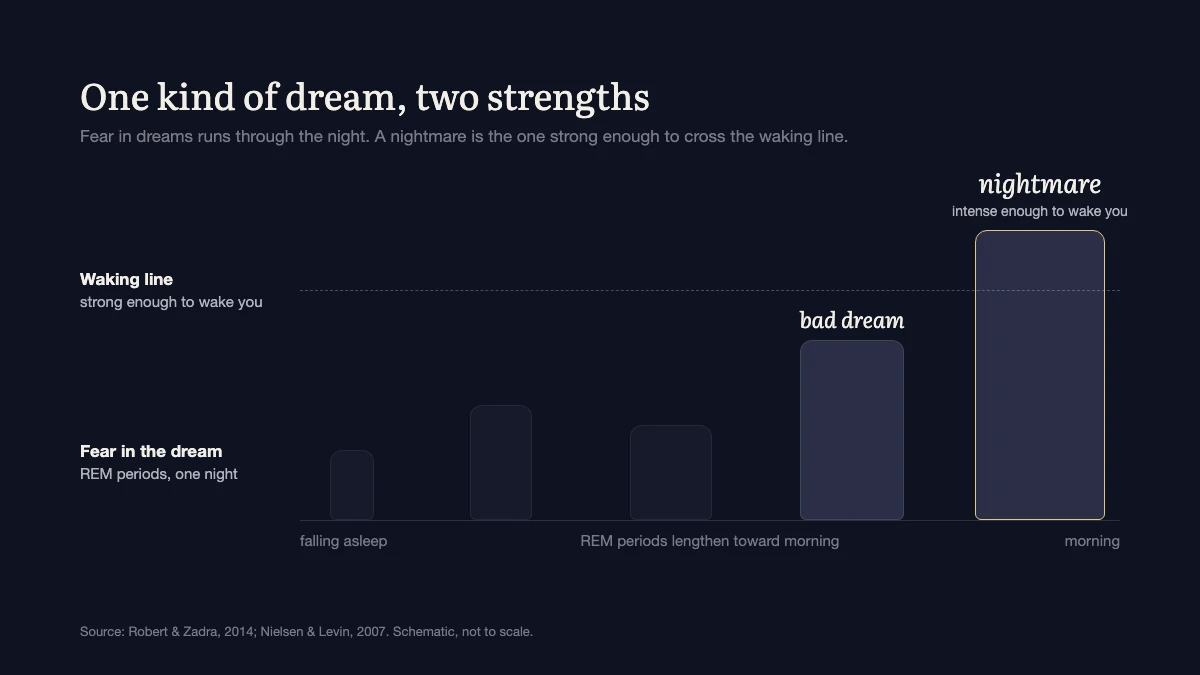
So the frightening dream is not the system failing to run. It is the system running hard enough that you noticed.
Why do nightmares come in hard weeks?
Because dreams follow waking life, and nightmares follow its pressure most closely. This is the continuity between days and nights that runs through most of dream research.
Two natural experiments show it at scale.
- After September 11, 2001. Ernest Hartmann and Tyler Brezler studied 44 people who had recorded their dreams for years, comparing the last 10 dreams before the attacks with the first 10 after. The dreams were not longer, and they did not fill with planes or towers. What changed was the central image, the single most powerful picture in each dream, which became significantly more intense. It is the same measure Hartmann used for tidal-wave dreams: the feeling arrives first, and the dream finds a picture to hold it.
- The 2020 lockdown. In the sixth week of Finland’s lockdown, Anu-Katriina Pesonen and colleagues surveyed 4,275 people. Respondents slept more, yet 26% reported more nightmares than before. Mapping 811 dream reports into clusters, the team found that 11 of the 20 bad-dream clusters were pandemic-specific: people ignoring distancing, contagion, overcrowded travel, the elderly in trouble, and the apocalypse.
The 9/11 finding is the quietly important one. The dreams didn’t replay the event. They carried its emotional weight in whatever imagery each dreamer already had. A nightmare in a hard week is rarely about the hard week in so many words. It is about the feeling, dressed in your own furniture.
Can food or sleeping position cause nightmares?
The folk explanations have been studied, a little, and the results are more modest than the folklore.
Food is the oldest suspect. Winsor McCay built a newspaper strip, Dream of the Rarebit Fiend, around a cheese dish eaten too late, starting in 1904. In 2015, Nielsen and Russell Powell gave that its scientific name. Of 396 students surveyed, 17.8% believed food affected their dreams, and dairy was the most blamed category. The better clue was elsewhere: students who reported disturbing dreams also reported poorer sleep. A late heavy meal may matter less for what it contains than for how it breaks up the night, and broken sleep is what lets a dream be remembered at all.
Sleeping position has one small, memorable study. In 2004, Agargun and colleagues asked 63 adults about their usual side: 40.9% of left-side sleepers reported nightmares, against 14.6% of right-side sleepers. The authors called it preliminary, and with 22 left-side sleepers it is. Note it, and hold it lightly.
Why do I keep having nightmares?
This is the question most people bring at 4 a.m., and the research suggests a reframing. “Keep having” usually means a cluster: a run of bad nights inside a particular stretch of life. Clusters are exactly what memory is worst at seeing, because, as Zadra and Donderi found, memory undercounts.
What makes a cluster readable is a record. If you want to see your own pattern, these are the details worth noting each time:
- The date and the hour you woke. Late-night timing points to REM; the date lets you line the dream up with the week.
- The main emotion, named precisely. Fear, or the 35% that are something else: grief, shame, frustration.
- The central image. The one picture you’d draw if you could draw only one.
- Whether it repeated. A dream that returns belongs with recurring dreams, which read best as a series.
- Whether you could move. Waking unable to move, with a presence in the room, is sleep paralysis, a different event with a different mechanism.
Five dated entries say more than one vivid memory. They show which weeks the nightmares belong to, and that is where their meaning lives, in your history rather than a dictionary.
What was in yours?
Here is the part the research can’t do for you. Nielsen and Levin can tell you why the alarm went off. Hartmann can tell you why the image was so strong. Neither can tell you why yours was set in your grandmother’s kitchen, or why the person you couldn’t reach was that person.
Those details fade fast, so the minute after waking is when to keep them. Speaking the account aloud is quicker than writing when your hands are still shaking a little, which is the design brief behind a voice-first journal like Dreamsay: the recording is transcribed on the phone in your hand. Your voice never leaves your device. A notebook works too. What matters is that a record exists, because a nightmare becomes readable only alongside the others.
When is it more than a dream?
If nightmares come often enough to wear down your sleep or follow you into the day, that is worth raising with a doctor. The concern is the lost sleep, not the dream. For most people on most nights, a nightmare is what the research describes: the dreaming brain doing its ordinary work on fear, loudly enough that, for once, you woke up to hear it.
Common questions
Why do I keep having nightmares?
Nightmares tend to cluster around pressured stretches of waking life. After 9/11, long-term dream recorders showed more intense central images, and in Finland's 2020 lockdown 26% of 4,275 respondents reported more nightmares than before. A dated record of your own nightmares is the most direct way to see which weeks they belong to.
What is the difference between a nightmare and a bad dream?
Researchers usually draw the line at waking: a nightmare is frightening enough to wake you, a bad dream is not. A 2014 study of 9,796 home-logged dreams found that nightmares held more aggression and failure and were rated as more intense, and concluded the two are one phenomenon at different strengths.
Can food give you nightmares?
The evidence is thin, but the belief is common. In a 2015 survey of 396 students, 17.8% thought food affected their dreams, with dairy most often blamed. Students who reported disturbing dreams also reported poorer sleep, which may be the real link: whatever fragments sleep makes a frightening dream more likely to be remembered.
Are nightmares more common at the end of the night?
Yes, as a rule. Nightmares come mostly from REM sleep, and REM periods grow longer and more intense toward morning, so the hours before waking carry the most vivid dreaming. A frightening experience early in the night, with little memory of a story, is more likely a different event from deep non-REM sleep.
Do nightmares serve a purpose?
One leading model says ordinary dreaming helps the brain process fear, and a nightmare is that work overloaded. A 2019 study of 89 people supports the first half: those with more fear in their dreams showed calmer brain responses to frightening pictures while awake. The finding is correlational, so the direction is not yet settled.
Sources
- Nielsen & Levin (2007), Nightmares: a new neurocognitive model, Sleep Medicine Reviews 11(4), 295-310
- Sterpenich, Perogamvros, Tononi & Schwartz (2019), Fear in dreams and in wakefulness: evidence for day/night affective homeostasis, Human Brain Mapping 41(3), 840-850
- Robert & Zadra (2014), Thematic and content analysis of idiopathic nightmares and bad dreams, Sleep 37(2), 409-417
- Zadra & Donderi (2000), Nightmares and bad dreams: their prevalence and relationship to well-being, Journal of Abnormal Psychology 109(2), 273-281
- Sandman, Valli, Kronholm, Ollila, Revonsuo, Laatikainen & Paunio (2013), Nightmares: prevalence among the Finnish general adult population and war veterans during 1972-2007, Sleep 36(7), 1041-1050
- Schredl & Reinhard (2011), Gender differences in nightmare frequency: a meta-analysis, Sleep Medicine Reviews 15(2), 115-121
- Hartmann & Brezler (2008), A systematic change in dreams after 9/11/01, Sleep 31(2), 213-218
- Pesonen, Lipsanen, Halonen, Elovainio, Sandman, Mäkelä, Antila, Béchard, Ollila & Kuula (2020), Pandemic dreams: network analysis of dream content during the COVID-19 lockdown, Frontiers in Psychology 11, 573961
- Nielsen & Powell (2015), Dreams of the Rarebit Fiend: food and diet as instigators of bizarre and disturbing dreams, Frontiers in Psychology 6, 47
- Agargun, Boysan & Hanoglu (2004), Sleeping position, dream emotions, and subjective sleep quality, Sleep and Hypnosis 6(1), 8-13
Keep reading
What is sleep paralysis?
Waking up unable to move, sure someone is in the room. What sleep paralysis is, why the body stays switched off, and why every culture has a name for it.
What do recurring dreams mean?
Most people have a dream that keeps coming back. What research says recurring dreams are doing, why they cluster in hard seasons, and how to read yours.
What does it mean to dream about water?
Water dreams are rarely one symbol. What research says about swimming, floods, and tidal waves, the readings that recur across cultures, and how to find yours.
Dreamsay readings — and these notes — are for entertainment and personal reflection, not medical or psychological advice.