What does it mean to dream about water?
By Nora Bennett ·
Nora Bennett writes Notes on dreaming, the Dreamsay journal on dream science, recall, and what your own history can tell you that a dictionary can't.
Dreaming of water rarely carries one fixed meaning, and it is not mostly a nightmare image. Across research and tradition, water tends to be read as a picture of feeling itself: calm water for ease, rising water for being overwhelmed, swimming for moving through something. What yours means depends on the water’s state and your history with it.
That’s the short answer. The longer one is more interesting, because no other dream image covers so wide a range of moods. The same element that drowns you on Tuesday carries you, weightless, on Thursday.
How common are water dreams?
Common, and more often pleasant than the reputation suggests. When Nielsen and colleagues gave the 55-item Typical Dreams Questionnaire to 1,181 first-year university students in 2003, 34.3% reported having dreamed of swimming, ranking it eighteenth of the fifty-five themes. The same survey found floods or tidal waves at 12.4%, far down the list at forty-sixth.
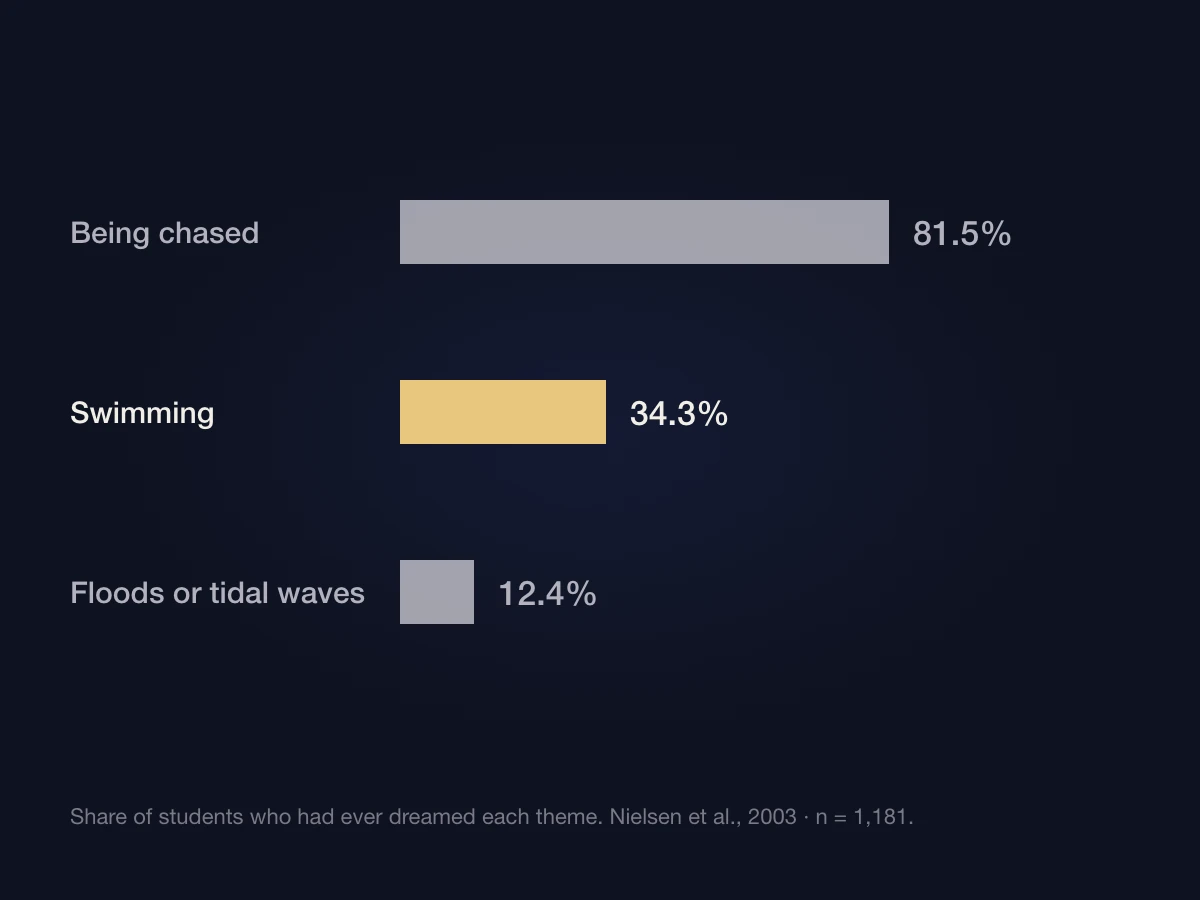
When the researchers sorted the themes into families, swimming landed among the positive ones, next to finding money and eating delicious food. Floods landed among the disasters, next to tornadoes, earthquakes, and fire. So the water dream people fear is real, but it is the minority. The one they have more often is a swim.
Flood and tidal-wave dreams were also significantly more common in the younger half of the sample: 16.2% of students aged 18 and under, against 10.5% of those 19 and older. None of this puts water near the top of the chart. That spot belongs to being chased, reported by 81.5%. Water is simply one of the species’ standards, like falling or teeth coming loose, with a noticeably better mood on average.
Why does the sleeping mind reach for water?
Part of the answer is embarrassingly literal. In 1958, William Dement and Edward Wolpert sprayed a fine mist of cold water on the skin of sleepers in REM sleep, then woke them and asked what they had been dreaming. Across 33 trials in which the sleeper did not wake from the spray itself, the water turned up in the dream report 42% of the time: a sudden rainfall, a leaking roof, someone squirting the dreamer. A tone played in the room made it into only 9% of dreams, and a flashing light into 23%. Water on the skin was the most persuasive of the three.
The same study sent a few sleepers to bed after a day without fluids. Of 15 dream reports collected, five contained thirst-related content. Before you read a water dream as a message from the depths, it is worth glancing at the glass on the nightstand, and the window you left open.
The rest of the answer is the one that makes water worth reading at all. Dream content tends to track waking life, especially its feelings, and water is the one image that can take any feeling’s shape. It can be still or violent, shallow or bottomless, warm or freezing, clear or thick with silt. A mind looking for a picture of how a week felt has no more flexible material to hand. That is also why the leading theories of why we dream, which disagree about most things, all treat emotion as a large part of what dreams are made of.
Why do tsunami and flood dreams feel so big?
Because the wave is usually the size of a feeling, not of an event. The dream researcher Ernest Hartmann built a long line of work around what he called the central image of a dream: the single most powerful picture in it. One image kept returning in his collections: I was swept away by a huge tidal wave. It turned up after fires, after attacks, after very different frightening experiences, none of which involved water. Hartmann’s reading was that the wave does not depict what happened. It depicts how it felt: overwhelmed.
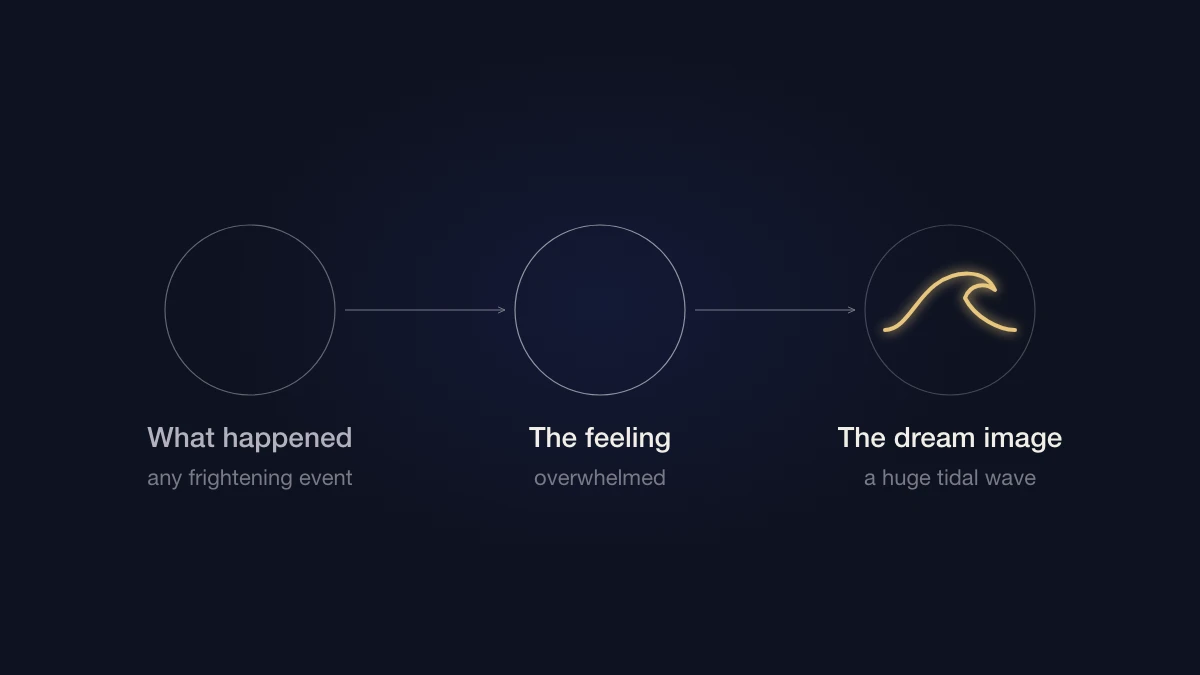
He later tested the idea at scale. In a 2008 study in Sleep, Hartmann and Tyler Brezler collected dreams from 44 people across the United States who had kept dream journals for at least two years: the last ten each person recorded before September 11, 2001, and the first ten after, 880 dreams in all, scored blind. After 9/11, the central images grew significantly more intense. The dreams did not fill with airplanes or tall buildings, and not a single dream, before or after, replayed the attacks as they had appeared on television. The dreaming mind did not replay the event. It turned up the volume on the feeling.
That is the most useful thing to know about a tsunami dream. A wave that fills the whole sky is a measurement, not a forecast.
What does water mean across cultures?
This is where the dream dictionary quietly falls apart. If water carried one built-in meaning, the traditions should roughly agree. They agree only that it matters.
| Tradition | Water in a dream tends to mean |
|---|---|
| Classical Greek dream books | The state of your affairs, read off the surface: a calm sea for smooth going, a rough one for trouble ahead |
| Chinese folk belief | Wealth and flow: water as the thing that moves money and fortune toward a household |
| The biblical flood | An ending that clears the ground: destruction, and then a world starting over |
| Freudian reading | Birth: Freud held that plunging into water or climbing out of it often pictured being born |
| Jungian reading | The unconscious itself: “water is the commonest symbol for the unconscious,” in Jung’s phrase |
| Western folk omen | Luck, sorted by clarity: clear water good, muddy water bad. There is no evidence for this |
Read the column top to bottom and the same night’s swim is money, birth, the unconscious, a business forecast, and a clean slate. None of these is wrong as a record of what people made of water. All of them fail as a lookup. Which is exactly why the reading has to come from somewhere else.
Calm, rising, or deep: which water was it?
Set the traditions beside the research and a few readings recur often enough to test against your own life, not as verdicts but as suspects. The state of the water is the first clue, and the feeling it gave you is the second.
Calm or clear water. Ease, or relief after a stretch without it. Many people meet still water in weeks when something has finally settled.
Rising water or a flood. Something arriving faster than you can manage it. A flood indoors is often read as that pressure reaching the private parts of life, the ones with walls.
Going under. The drowning dream tends to land in weeks that feel airless: too much to hold, nowhere to put it down.
Swimming or crossing. Moving through something rather than being moved by it. Whether the swim felt effortless or exhausting is most of the reading.
The wave. As above: a feeling at full size, often after a week that was, by any measure, a lot.
None of these is the meaning. They are the recurring readings, and the honest use of them is as questions.
How do you find what your water means?
Skip the dream dictionary and run the comparison the dictionary can’t: your dream against your life, across time.
- Date it. Write the dream down on waking, in as much detail as you can keep. Where was the water, how deep, how fast, how cold?
- Name the water’s state and your feeling. Calm or rising, clear or dark; afraid, calm, exhilarated. The feeling is the most trustworthy thing a dream carries, and water dreams carry it unusually plainly.
- Note the week, not just the night. What was arriving, piling up, or finally settling around that date?
- Check the body. Thirst, a cold room, rain on the window, a full bladder. The 1958 spray study says the sleeping mind borrows these readily, and a literal source does not cancel the feeling the dream built around it.
- Wait for the second one. A single flood is weather. Two or three, each landing in the same kind of week, are a recurring dream, and the pattern across them is yours, not the species’.
This is the quiet argument for keeping a dream journal of any kind: water dreams are vivid on waking and slippery by breakfast, and the details that go first, the depth, the temperature, the way the water moved, are the ones that say what the dream was about. This is why Dreamsay lets you speak the dream the moment your eyes open and transcribes it on the device in your hand. Your voice never leaves your device. The record stays yours, and so does the reading it eventually allows.
When is it more than a dream?
If drowning or flood dreams arrive night after night and break your sleep, or follow a frightening experience that is still fresh, those are matters for waking life: the people around you, or a professional. The dream was the messenger, not the problem. And whatever a water dream is, it is not a forecast. No tradition of evidence supports dreams predicting events, and the flood you dreamed of is not on its way.
For everything else, water is what it has been in every dream record anyone has kept: the most changeable image the sleeping mind owns, and so the one most worth dating. Calm one month, rising the next. What it means is a question only your own history can answer.
Common questions
What does it mean to dream about a tsunami?
Most often, the size of a feeling. The dream researcher Ernest Hartmann found that the image of being swept away by a huge tidal wave turns up after many different kinds of frightening events, none of them involving water. He read it as a picture of feeling overwhelmed, not of anything that happened or will happen.
What does it mean when you dream about drowning?
Usually that something in waking life feels like it is closing over your head: too much work, too much feeling, too little air in a week. Dream content tends to track waking concerns, so the useful question is what that week held. A drowning dream is not an omen, and it is not a forecast.
What does it mean to dream about a flood in your house?
A house is the dream's usual picture of your own life, and water coming in suggests something arriving faster than you can manage it. Date the dream and note the week. If the flooded house returns, compare the weeks: what they share is a better answer than any dictionary entry.
Is dreaming about water good or bad luck?
Neither. No evidence supports dreams predicting events, and folk traditions cannot even agree on the sign: some read clear water as fortune and muddy water as trouble, others read all water as wealth. The dream describes a present feeling, and the feeling is the part worth reading.
Why do I dream about swimming?
You have plenty of company. In a 2003 survey of 1,181 university students, 34.3% had dreamed of swimming, and researchers grouped it with the pleasant themes rather than the frightening ones. Many people read it as moving through something with ease, or at least staying afloat. Your own swimming dreams will say which.
Sources
- Nielsen, Zadra, Simard, Saucier, Stenstrom, Smith & Kuiken (2003), The Typical Dreams of Canadian University Students, Dreaming 13(4), 211–235
- Dement & Wolpert (1958), The relation of eye movements, body motility, and external stimuli to dream content, Journal of Experimental Psychology 55(6), 543–553
- Hartmann & Brezler (2008), A Systematic Change in Dreams after 9/11/01, Sleep 31(2), 213–218
Keep reading
What does it mean to dream about someone dying?
Death dreams are common and rarely about death itself. What the research says, why dreams of the dead are usually comforting, and how to find what yours means.
Why did I dream about my ex?
Dreams about an ex are common, sometimes years later. What the research actually says, the readings that recur, and how to find what yours is about.
What does it mean to dream about snakes?
Snake dreams are one of the oldest, most cross-cultural dream images. What research says, the readings that recur across cultures, and how to find yours.
Dreamsay readings — and these notes — are for entertainment and personal reflection, not medical or psychological advice.